


Twoleaf Miterwort
mitella diphylla
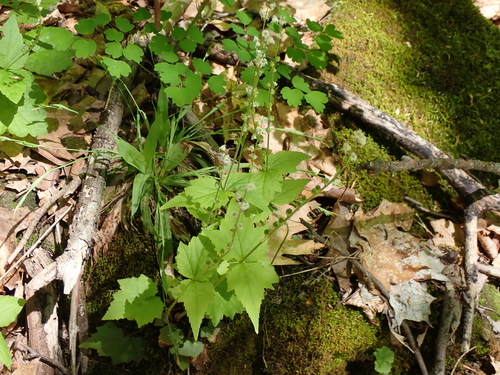
Twoleaf Miterwort (Mitella diphylla), also known as Bishop's Cap, is a delicate and enchanting perennial wildflower native to the rich, moist forests of eastern North America. Standing on slender stems, it is easily recognized by its unique, tiny, snowflake-like white flowers that bloom in mid-to-late spring. The plant gets its common names from the shape of its tiny seedpods, which resemble a bishop’s miter (or cap), and the single pair of opposite, stemless leaves that sit midway up the flowering stalk.
Habitat: Found in rich, moist deciduous forests, often on slopes, near streams, or in shaded ravines with calcareous soils.
This dainty herb grows 20 to 45 cm tall, featuring a basal clump of heart-shaped, lobed, hairy leaves. The most striking visual cue is the single pair of opposite, stalkless (sessile) leaves positioned halfway up the hairy flowering stem. From April to June, the stem is topped by a loose, elongated cluster of tiny, white, snowflake-like flowers, each only about 4-6 mm wide. Closer inspection reveals exquisitely fringed, cup-shaped petals that give the bloom its crystalline appearance.
Category
PlantsRarity
Common
Danger
1/5 · Very low
Snaps
7
Its seeds are small, glossy, and pitch-black, sitting inside open cup-like structures that resemble tiny nests containing miniature eggs.
The common names 'Miterwort' and 'Bishop's Cap' both refer to the small, cup-shaped seedpods which, when open, resemble a liturgical miter worn by bishops.
The incredibly intricate, fringed petals look like delicate ice crystals under a magnifying glass, making it one of the most structurally complex flowers in the woodland understory.
Produces intricate, deeply-lobed, fringe-like petals that increase surface area for tiny pollinators while closely resembling miniature, delicate ice crystals.
Uses open, cup-shaped seed capsules that face upward, relying on the physical kinetic energy of falling raindrops to splash and fling the mature seeds away from the parent plant.
Features a unique pair of opposite, stemless leaves midway up the flowering stalk that optimize sunlight capture in the densely shaded forest understory without requiring extra energy to grow petioles.
As a photoautotrophic plant, the Twoleaf Miterwort produces its own energy via photosynthesis, absorbing sunlight, carbon dioxide, and water.
Syrphus ribesii
Syrphid flies visit the tiny flowers for nectar and pollen, helping pollinate the plant.

Odocoileus virginianus
Deer occasionally graze on the foliage of Miterwort, though it is not a primary food source.
_and_beneficial_bacteria_on_plant_performance_and_soil_fertility.webp&width=800)
Glomus intraradices
Forms symbiotic mycorrhizal relationships in the soil to enhance nutrient and water absorption.
No trait badges are assigned for this object yet.
No aliases listed yet.
Collections for this object will appear here as more themes are added.
Danger
1/5 · Very low
No special safety notes yet.
The easiest way to identify Twoleaf Miterwort is to use the Snappit nature identifier app.
20-45 cm
0.01-0.05 kg
3-10 years
As a photoautotrophic plant, the Twoleaf Miterwort produces its own energy via photosynthesis, absorbing sunlight, carbon dioxide, and water.
Found in rich, moist deciduous forests, often on slopes, near streams, or in shaded ravines with calcareous soils.
Zoom in to split clusters and explore where this object has been snapped.
May 17, 2026
Berkshire Botanical GardenPhoto attribution
no rights reserved
License: CC0 1.0 ↗
Image may be shown cropped inside the card frame.

Massachusetts, US
You might spot Maidenhair Spleenwort and Red Trillium.
View guide →

Massachusetts, US
You might spot Common Eastern Bumble Bee and Eastern Skunk Cabbage.
View guide →
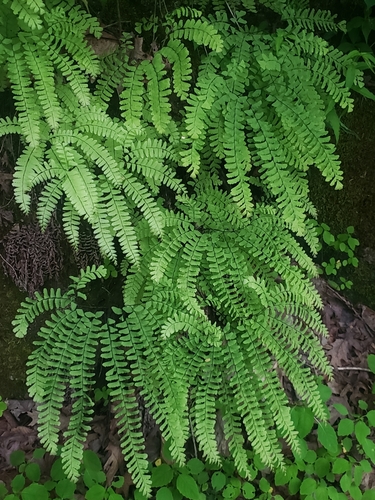
Iowa, US
You might spot Northern Maidenhair Fern and Wood Nettle.
View guide →

Vermont, US
You might spot Asian Bittersweet, Alder Buckthorn, and Eastern Newt.
View guide →

Vermont, US
You might spot Eastern White Pine, Staghorn Sumac, and Box Elder.
View guide →

Vermont, US
You might spot Northern Cardinal, Wood Frog, and White-Breasted Nuthatch.
View guide →
Take the discovery with you
Snap it with Snappit to identify it, learn what makes it special, and add the discovery to your collection.











.jpg&width=800)



_001.jpg&width=800)




