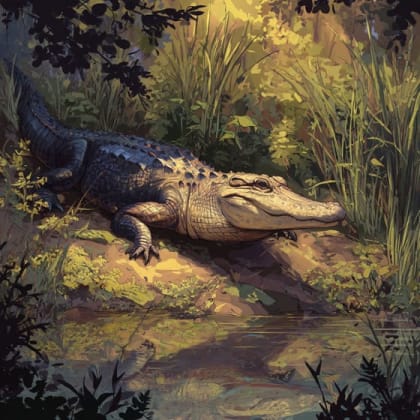





American Alligator

Explore the rich history of South Carolina's Lowcountry rice culture.
Explore the rich history of South Carolina's Lowcountry rice culture. The Pee Dee River Rice Planters Historic District is a vast 5,100-acre expanse in Georgetown County, encompassing the remnants of seventeen antebellum rice plantations along the Pee Dee and Waccamaw Rivers. This nationally recognized historic district offers a poignant glimpse into an agricultural empire that once dominated the region, showcasing the architectural, engineering, and social history of rice cultivation.
Visitors can observe the remarkable engineering feats of the era, including extensive historic rice fields, intricate canal systems, dikes, and flood control trunks designed for tidal irrigation. The district also features surviving architectural elements such as grand plantation houses, historic rice barns, a rice mill and chimney at Chicora Wood, and collections of outbuildings, including rare slave cabins at Arundel. Majestic live oaks, characteristic of the Lowcountry landscape, dot the historic grounds, providing a sense of timeless beauty.
While many of the individual properties within the district are privately owned and not open to the public, the district itself offers a compelling journey through a pivotal period of American history. The preserved landscape, visible from public roads and accessible river points, invites reflection on the immense human effort and the complex social structures that built this rice empire. It's a powerful destination for those seeking to understand the enduring legacy of the Lowcountry's agricultural past. Explore the grounds like a pro—download the Snappit app to instantly identify animals and plants.
The Pee Dee River Rice Planters Historic District flourished as a center of rice production from approximately 1750 to 1910. During this period, Georgetown County led American rice production, with South Carolina as a whole being the nation's primary rice producer. This intensive agrarian system relied heavily on enslaved African labor to construct and maintain the vast network of flooded fields, dikes, canals, and trunks, which were essential for the tidal cultivation method. A significant engineering advancement, the tidal culture of rice, allowed planters to flood fields using river tides without mechanical pumping, dramatically increasing yields. However, the Civil War and the subsequent emancipation of enslaved people dismantled the labor system that underpinned these plantations, leading to widespread abandonment and eventual decline. Furthermore, devastating hurricanes in the late 19th and early 20th centuries destroyed many of the dikes, making large-scale rice production unsustainable. The district was listed on the National Register of Historic Places in 1983 to preserve its intact representation of this significant rice culture.
Drive along public roads like Plantersville Road to observe the overall landscape and historic remnants.
* Utilize public access points to the Pee Dee River for scenic views, photography, and birdwatching.
* Consider a boat tour (if available in the wider Georgetown area) for riverine perspectives of the historic lands.
* Visit nearby public historic sites or museums in Georgetown to gain further context on rice culture and plantation life.
Summers (June-August) can be very hot and humid, with a higher chance of thunderstorms. Winters (December-February) are generally mild but can have chilly days. Bird activity, especially waterfowl, may be higher in cooler months within the wetlands.
As a large, dispersed historic district, accessibility varies. Public roads are paved, but views of specific features might be limited. Public boat ramps provide water access. Information on specific wheelchair access for individual properties is not generally available due to their private nature.
The expansive, preserved historic rice fields with their intricate networks of canals, dikes, and trunks, visible from public roads, are central to the district's significance. These represent a monumental feat of antebellum engineering.
While most plantation houses are private, some may be glimpsed from public roads. Noteworthy examples include the styles of the plantation houses at Exchange, Rosebank, Chicora Wood, and Dirleton, and the historic rice barns at Hasty Point and Exchange.
Experience the natural environment that enabled the rice culture. Public boat ramps, such as one at Dirleton Plantation, offer opportunities for boating, fishing, and birdwatching on the Great Pee Dee River.
These iconic trees, particularly prominent at locations like Chicora Wood, offer excellent photographic opportunities and evoke the grandeur of the historic plantations.
Each card links to a full Explore page with photos, traits, and fun facts.
Start with the big picture, then zoom in to explore individual wildlife observations around this place.
Respect Private Property
Be mindful that almost all properties are privately owned. Do not trespass or disturb residents.
Plan Your Route
Use a map to identify public roads that traverse the district to maximize your viewing opportunities of the historic landscape and rivers.
Bring Binoculars and a Camera
These will enhance your ability to view distant architectural features and wildlife, and capture the scenic beauty of the Lowcountry.
Consider River Access
If interested, look for public boat ramps along the Pee Dee River (such as at Dirleton Plantation) to experience the district from the water, which was its historical lifeline.
Combine with Georgetown
Visit historic Georgetown, a short distance away, to explore museums and interpretative centers that provide context for the rice-planting era.
Wear Insect Repellent
Especially during warmer months, mosquitos and other biting insects can be prevalent in wetland environments.
Mar 8, 2026
Mar 8, 2026
Mar 8, 2026
Mar 8, 2026
Mar 8, 2026

Maryland, US
You might spot White-Tailed Deer and Eastern Gray Squirrel.
View guide →
.jpg)
District of Columbia, US
You might spot Eastern Gray Squirrel, Duck, and House Sparrow.
View guide →

Illinois, US
You might spot American Robin, Canada Goose, and House Sparrow.
View guide →

Virginia, US
You might spot Spotted Lanternfly and Northern Cardinal.
View guide →
Take the discovery with you
Identify the wildlife you spot, learn as you go, and keep a collection of the adventure.