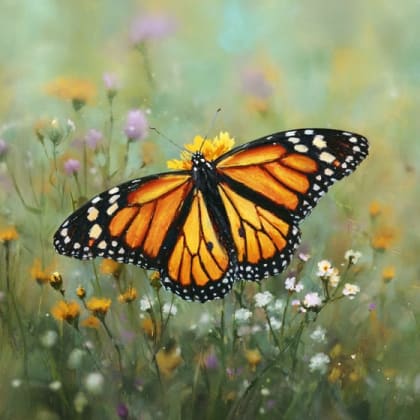





Monarch Butterfly
Pilot Grove State Preserve offers a tranquil escape into Iowa's natural and historical heritage.
Pilot Grove State Preserve offers a tranquil escape into Iowa's natural and historical heritage. This 7-acre preserve, located in Iowa County, safeguards a precious remnant of the state's original landscape, where bur oak woodlands meet patches of native prairie. Dedicated to preserving a glimpse into Iowa's pioneer past, it provides a serene setting for nature observation and reflection.
The preserve is characterized by its towering bur oak, hickory, and walnut trees, providing a vital woodland habitat. In spring, the forest floor awakens with a vibrant display of wildflowers such as Mayapple, Columbine, Virginia bluebells, and Solomon's seal. Adjacent to the woodland, a small prairie patch bursts with native grasses like Big Bluestem and Indian Grass, alongside beautiful prairie wildflowers such as Leadplant, attracting pollinators like the Monarch butterfly. Visitors might also spot common woodland creatures like the Eastern Cottontail or Fox Squirrel, and hear the calls of various bird species like the Northern Cardinal and American Robin.
Visiting Pilot Grove State Preserve is a journey back in time, offering a unique blend of natural beauty and historical significance. It's a place to slow down, appreciate the resilient flora and fauna, and imagine the pioneers who once relied on this very grove as a guiding landmark across the vast prairie. Its small size ensures an intimate experience, perfect for a peaceful stroll or quiet contemplation amidst nature's gentle embrace. Eager to name that creature? Identify any animal you find during your visit using the Snappit app.
Pilot Grove State Preserve holds deep historical roots as a pivotal landmark for early Iowa settlers. In the mid-1800s, this wooded knoll rose distinctly above the surrounding prairie, serving as a crucial navigational guide for pioneers traveling to and from Marengo, the county seat, earning it the name "Pilot Grove." Evidence of old wagon trials can still be seen winding through the timber, connecting visitors to this rich past. A significant portion of the preserve, along with an adjacent pioneer cemetery, was recognized for its historical importance and placed on the National Register of Historic Places in 1978. The Kelting family, long-time owners of the land, donated the grove to the Iowa Conservation Commission in 1980 with the specific goal of restoring it to its mid-19th-century condition. Later that same year, it was formally dedicated as a historical state preserve, ensuring its protection for future generations.
Enjoy short walks through the woodland and prairie, birdwatching, photography, historical exploration at the pioneer cemetery, and observing native plants and insects.
Spring: Abundant wildflowers like Virginia Bluebells and Solomon's Seal; migratory bird activity.
Summer: Full canopy, warm weather, blooming prairie plants, active insects (e.g., Monarch butterflies).
Fall: Striking fall foliage from the oak and hickory trees; cooler temperatures, ideal for hiking.
Winter: Quiet solitude, potential for tracking wildlife in snow, stark beauty of bare trees.
Specific accessibility information is not widely published. Given its nature as a state preserve with potentially unpaved or informal paths, it's best to anticipate limited wheelchair accessibility, especially within the wooded areas and prairie patches.
The mature Bur Oak woodland, providing cool shade and habitat.
Patches of native prairie with Big Bluestem and Leadplant.
Spring wildflower displays including Mayapple, Columbine, and Virginia Bluebells.
The adjacent Pioneer Cemetery, offering a historical perspective.
Each card links to a full Explore page with photos, traits, and fun facts.
Start with the big picture, then zoom in to explore individual wildlife observations around this place.
Wear appropriate footwear
** Trails may be unpaved and uneven, especially after rain.
Bring insect repellent
Especially during warmer months when ticks and mosquitoes may be present.
Carry water
There are no facilities on-site.
Respect the historical nature
Observe, but do not disturb, any historical markers or the pioneer cemetery.
Visit during spring for wildflowers
This is the prime time to see many of the preserve's unique floral displays.
Practice Leave No Trace principles
Pack out everything you pack in to help preserve this natural and historical site.
Oct 21, 2025
Oct 21, 2025
Oct 20, 2025
Sep 1, 2025
Sep 1, 2025

Maryland, US
You might spot White-Tailed Deer and Eastern Gray Squirrel.
View guide →
.jpg)
District of Columbia, US
You might spot Eastern Gray Squirrel, Duck, and House Sparrow.
View guide →

Illinois, US
You might spot American Robin, Canada Goose, and House Sparrow.
View guide →

Virginia, US
You might spot Spotted Lanternfly and Northern Cardinal.
View guide →
Take the discovery with you
Identify the wildlife you spot, learn as you go, and keep a collection of the adventure.