





Green Stink Bug
Chinavia hilaris
The Green Stink Bug is a bright green insect that can be found in gardens and fields. They have a funny smell when they feel scared, which helps keep them safe from predators.
Habitat: Urban areas, Gardens
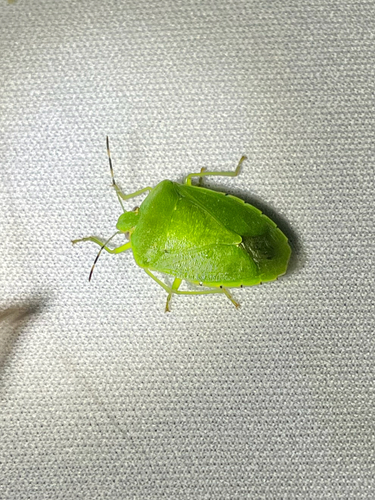
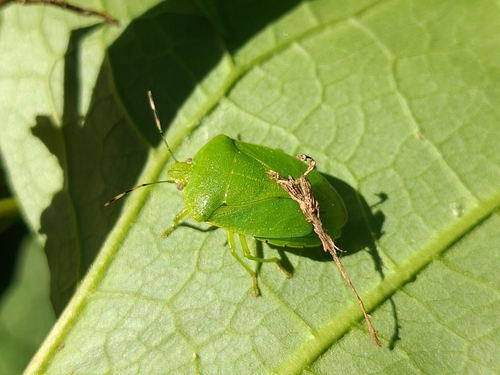
The Green Stink Bug has a bright, uniform emerald green, shield-shaped body, often with a narrow orange-yellow line around its edges. Its membranous wing tips are typically reddish-brown, and it possesses prominent dark eyes, making it distinct from brown stink bug species.
Category
InsectsRarity
Common
Danger
1/5 · Very low
Snaps
9
During cold weather, these bugs seek shelter in homes or under bark to hibernate until spring!
If a plant is damaged by them, it can get unsightly dimples and brown spots, especially on fruits!
They lay their tiny, barrel-shaped eggs in neat, sticky rows on the underside of leaves!
Young stink bugs, called nymphs, are often dark with colorful spots, looking quite different from adults!
Green Stink Bug has a vibrant green body that helps them blend perfectly with leaves and plant stems.
Green Stink Bug can pierce plant tissues with its straw-like mouthparts to drink vital sap and juices.
Green Stink Bug has strong wings that help them fly to new feeding grounds or escape from danger.
They use their special mouthparts to sip juices from fruits, vegetables, and other plants!
Podisus maculiventris
preys on nymphs and adults
Trissolcus basalis
lays eggs in stink bug eggs

Glycine max
provides sap and nutrients
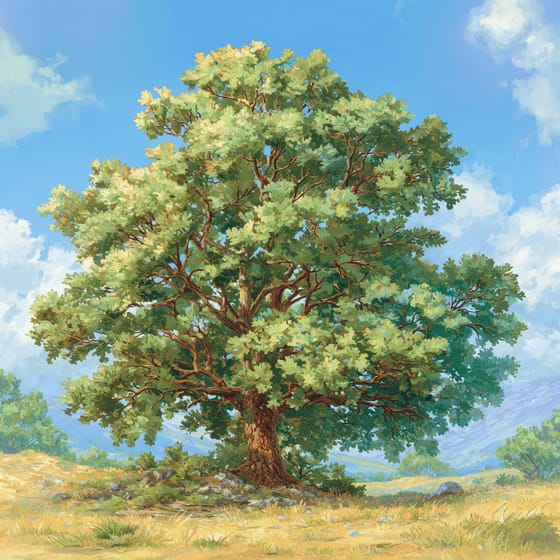
Quercus alba
provides overwintering habitat
Solitary animals live alone for most of their lives, only interacting with others for mating or parental care.
Camouflaged describes organisms that possess coloring or patterns that allow them to blend into their environment.
Colorful describes organisms or objects displaying a wide range of bright and distinct colors.
This trait characterizes organisms whose diet consists entirely or primarily of plant material.

Diurnal animals are primarily active during daylight hours, typically resting or sleeping at night.

This habitat trait indicates species that can coexist with humans in urban and suburban environments, utilizing man-made structures and green spaces.

Describes organisms that transfer pollen, enabling the fertilization and reproduction of plants.
No aliases listed yet.
Danger
1/5 · Very low
Don't touch them if you see one! They might smell funny.
The easiest way to identify Green Stink Bug is to use the Snappit nature identifier app.
25-30 mm
13-16 mm
60-180 days
4 km/h
They use their special mouthparts to sip juices from fruits, vegetables, and other plants!
Urban areas, Gardens
Foraging
Zoom in to split clusters and explore where this object has been snapped.
Jun 14, 2026
Ambler Heights Historic DistrictPhoto attribution
(c) Joey M, some rights reserved (CC BY)
License: CC BY 4.0 ↗
Image may be shown cropped inside the card frame.
May 31, 2026
PrallsvillePhoto attribution
(c) Susan Mott, some rights reserved (CC BY-SA)
License: CC BY-SA 4.0 ↗
Image may be shown cropped inside the card frame.

Ohio, US
You might spot Eastern Fox Squirrel and Spotted Lanternfly.
View guide →

Vermont, US
You might spot Eastern White Pine, Staghorn Sumac, and Box Elder.
View guide →

Maine, US
You might spot Pink Lady's Slipper, Wood Lily, and Great Blue Heron.
View guide →

Tennessee, US
You might spot Eastern Bluebird and Red-Shouldered Hawk.
View guide →
.jpg&width=800)
Kansas, US
You might spot Reticulated Giraffe, African Lion, and Tiger.
View guide →

Vermont, US
You might spot Eastern White Pine, Staghorn Sumac, and Box Elder.
View guide →
Take the discovery with you
Snap it with Snappit to identify it, learn what makes it special, and add the discovery to your collection.







.jpg&width=800)



