





American persimmon
Diospyros virginiana
The American persimmon is a sweet fruit tree that grows tall and has beautiful leaves. Its orange fruit is yummy and can be eaten when it's ripe, making it a favorite for many animals.
Habitat: Forests
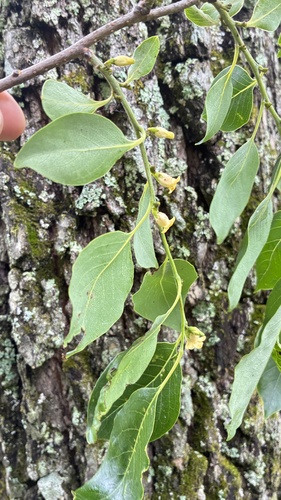
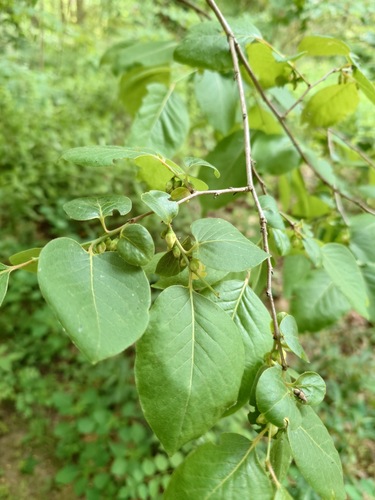
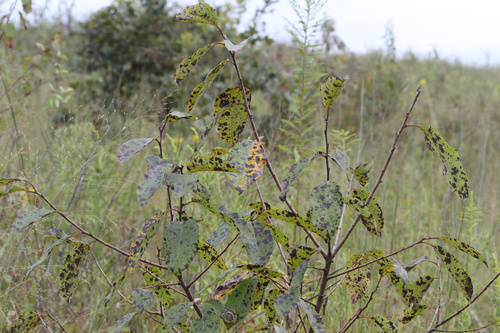
The American persimmon has distinctive blocky, dark gray-black bark and simple, oval leaves that turn fiery red-orange in autumn. Its small, pale yellow flowers give way to round, orange, sweet fruits that remain on branches into winter.
Category
PlantsRarity
Common
Danger
1/5 · Very low
Snaps
13
Eating an unripe persimmon makes your mouth feel like it's shrinking and puckering!
Its strong, dense wood is famous for making golf club heads and billiard cues!
Squirrels and raccoons can magically tell exactly when persimmons are perfectly ripe!
The word 'persimmon' means 'fruit-of-a-fire-red-dye' in an ancient Algonquian language!
American persimmon fruit is super astringent when unripe, making animals wait until it's perfectly sweet and soft to eat it!
It has a deep taproot that helps it find water deep underground, allowing it to survive even long, dry spells.
Its thick, blocky bark acts like a natural shield, helping the tree survive many forest fires.
Ursus americanus
bears feast on ripe, sugary fruits
Didelphis virginiana
opossums enjoy the sweet fallen fruit

Odocoileus virginianus
deer browse on its leaves and young twigs
Apis mellifera
bees visit its small, bell-shaped flowers
Deciduous plants periodically shed all their leaves, typically during autumn or dry seasons.
Shade tolerant plants are adapted to grow and thrive in areas with low light levels, requiring less direct sunlight.
Broadleaf trees are angiosperms characterized by flat, wide leaves that are typically shed annually in temperate climates.
Fruit-bearing plants produce fruits, which are the mature ovaries of flowering plants containing seeds.
A fruit tree is a perennial tree that produces fruit, which is edible to humans or animals.

Edible plants are those parts of a plant that are considered safe for human consumption.

Fall color refers to the seasonal change in foliage pigmentation, primarily in deciduous plants, displaying vibrant hues.

Forest habitats are terrestrial environments dominated by dense tree cover, supporting a high diversity of plant and animal life.
Danger
1/5 · Very low
Always ask an adult before picking or eating any fruit from trees.
The easiest way to identify American persimmon is to use the Snappit nature identifier app.
1000-2000 cm
600-1200 cm
1-2 cm
Late spring to early summer
Yes
None
Perennial
Zoom in to split clusters and explore where this object has been snapped.
May 21, 2026
Bernheim Forest and ArboretumPhoto attribution
(c) Anne H. Proffitt, some rights reserved (CC BY)
License: CC BY 4.0 ↗
Image may be shown cropped inside the card frame.
Apr 27, 2026
FruitvalePhoto attribution
(c) geotrope, some rights reserved (CC BY-SA)
License: CC BY-SA 4.0 ↗
Image may be shown cropped inside the card frame.
Sep 5, 2024
Harrell Prairie Botanical AreaPhoto attribution
(c) Samuel A Schmid, PhD, PWS, some rights reserved (CC BY)
License: CC BY 4.0 ↗
Image may be shown cropped inside the card frame.

Tennessee, US
You might spot House Sparrow, Northern Mockingbird, and Gulf Fritillary.
View guide →

Alabama, US
You might spot American Beautyberry, White-Tailed Deer, and Peppervine.
View guide →

Alabama, US
You might spot Anole, Bee, and Bristle Thistle.
View guide →

Texas, US
You might spot Eastern Fox Squirrel and Great-Tailed Grackle.
View guide →

Alabama, US
You might spot Anole, Bee, and Bristle Thistle.
View guide →

Georgia, US
You might spot Asian Lady Beetle, Anole, and Joro Spider.
View guide →
Take the discovery with you
Snap it with Snappit to identify it, learn what makes it special, and add the discovery to your collection.







.jpg&width=800)


_001.jpg&width=800)


