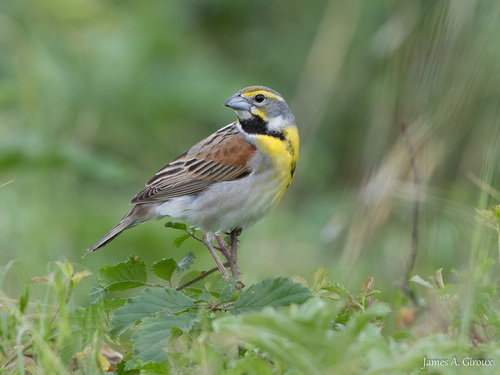


Dickcissel
spiza americana
The Dickcissel is a small, sparrow-like migratory bird that is a signature species of North American grasslands. Famous for its persistent, buzzing song that echoes across open fields, the male Dickcissel stands out with its striking yellow chest and a sharp black V-shaped bib, strongly resembling a miniature Eastern Meadowlark. During the spring and summer breeding season, these birds are highly territorial, but they undergo a dramatic behavioral shift as autumn approaches. For winter, they gather into colossal, highly social flocks containing thousands, and sometimes millions, of individuals to migrate to the agricultural fields and savannas of northern South America.
Habitat: Typically found in tallgrass prairies, weed fields, meadows, alfalfa pastures, and restored grasslands across the central United States.
About the size of a large sparrow, the Dickcissel measures roughly 14 to 16 centimeters in length with a stout, cone-shaped grey bill. Breeding males are easily identified by a bright yellow breast, a white throat bordered by a dark black patch or bib, a yellow stripe above the eye, and warm chestnut-colored patches on their shoulders. Females and non-breeding males are much duller, lacking the bold black bib and displaying a pale yellow breast, light brown streaks along their flanks, and a prominent whitish stripe above the eye, giving them a visual appearance similar to a House Sparrow.
Category
BirdsRarity
Common
Danger
1/5 · Very low
Snaps
4
Crop Protection: Farmers often welcome them during nesting season because a single pair can consume thousands of crop-eating grasshoppers to feed their young.
Onomatopoeic Moniker: The common name 'Dickcissel' is an imitation of the male's buzzy, persistent, multi-syllable breeding song.
Super-Flocks: On their wintering grounds in Venezuela, single roosts can host over three million birds, creating one of the most concentrated avian spectacles in the world.
The male sings a repetitive, metallic song sounding like 'dick-ciss-ciss-ciss' from elevated perches to defend nesting territories.
During winter migration, they aggregate into massive flocks of up to several million individuals to forage and roost together safely.
They display low nesting site fidelity, choosing new breeding locations each year based on rainfall patterns and vegetation density.
During the summer breeding season, Dickcissels feed heavily on protein-rich insects, whereas during migration and winter they transition almost entirely to eating various seeds.
.jpg&width=800)
Molothrus ater
The Brown-headed Cowbird frequently acts as a brood parasite, laying its eggs in the nests of Dickcissels, which often successfully raise the cowbird chicks.

Melanoplus differentialis
Dickcissels forage extensively on destructive agricultural insects, making grasshoppers one of their primary protein sources in summer.
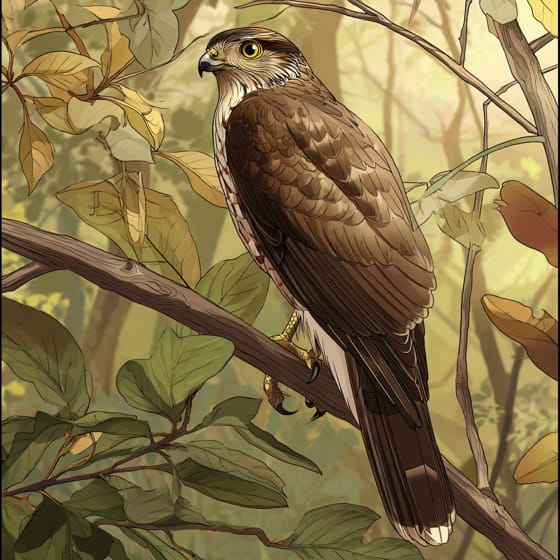
Accipiter cooperii
Coopers Hawks are swift aerial predators that hunt adult and fledgling Dickcissels in open agricultural borders and grasslands.
No trait badges are assigned for this object yet.
No aliases listed yet.
Collections for this object will appear here as more themes are added.
Danger
1/5 · Very low
No special safety notes yet.
The easiest way to identify Dickcissel is to use the Snappit nature identifier app.
14+ cm
24+ cm
0.023+ kg
3+ years
40 km/h
During the summer breeding season, Dickcissels feed heavily on protein-rich insects, whereas during migration and winter they transition almost entirely to eating various seeds.
Typically found in tallgrass prairies, weed fields, meadows, alfalfa pastures, and restored grasslands across the central United States.
Zoom in to split clusters and explore where this object has been snapped.

Illinois, US
You might spot Canada Goose, House Sparrow, and Rock Pigeon.
View guide →

Illinois, US
You might spot Canada Goose, House Sparrow, and Red-Winged Blackbird.
View guide →

Illinois, US
You might spot Osage-Orange, Cutleaf Teasel, and Red Clover.
View guide →
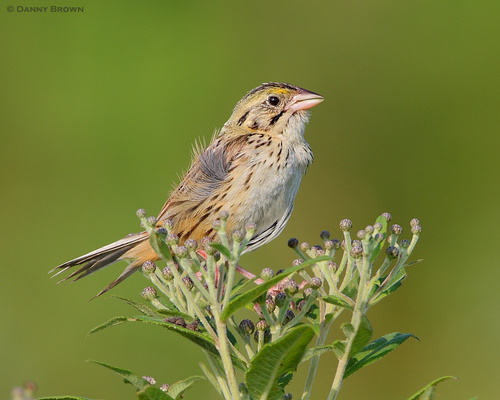
Iowa, US
You might spot Henslow's Sparrow, Grasshopper Sparrow, and Bobolink.
View guide →

Illinois, US
You might spot Prickly Cucumber and Golden Oyster Mushroom.
View guide →

Oklahoma, US
You might spot American Bison, Green Antelopehorns, and White-Tailed Deer.
View guide →
Take the discovery with you
Snap it with Snappit to identify it, learn what makes it special, and add the discovery to your collection.







.jpg&width=800)









