.jpg&width=800)





Eurasian Collared-Dove
Streptopelia decaocto
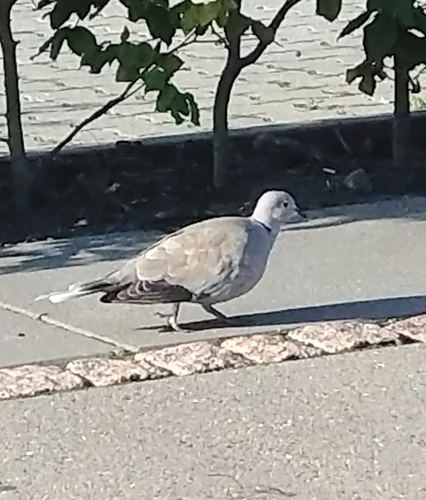
The Eurasian Collared-Dove is a gentle bird with a soft cooing sound. It has a distinctive black 'collar' on its neck and loves to perch on wires and trees in neighborhoods.
Habitat: Urban areas
The Eurasian Collared-Dove is a medium-sized bird, predominantly pale grayish-tan with a distinctive black half-collar on its nape. It has reddish eyes, dark primary flight feathers, and pinkish legs, making it visually distinct from a Mourning Dove.
Category
BirdsRarity
Common
Danger
1/5 · Very low
Snaps
38
A single pair can raise up to 5-6 broods in a year, leading to huge population booms!
Their famous "coo-COO-coo" call sounds a bit like they're saying their own name!
This dove dramatically spread across Europe and into North America in less than 100 years!
Unlike most birds, adult doves feed their chicks "crop milk," a special nutritious liquid!
Eurasian Collared-Doves can rapidly expand their range because of their ability to quickly adapt to new environments.
Eurasian Collared-Doves can raise multiple broods per year, which helps their populations grow very fast.
Eurasian Collared-Doves have a varied diet that helps them find food easily in many different habitats.
These doves mostly munch on seeds and grains, but also enjoy a few berries and tiny insects.
Feathered describes animals, primarily birds, possessing a covering of feathers.
Social animals live in organized groups, cooperating for survival benefits such as foraging, defense, and raising offspring.
Singing animals produce complex vocalizations, often for purposes of attracting mates, defending territory, or communicating within their species.
This trait characterizes organisms whose diet consists entirely or primarily of plant material.

This trait characterizes organisms with an exceptionally long lifespan compared to others of their kind.

Diurnal animals are primarily active during daylight hours, typically resting or sleeping at night.

This habitat trait indicates species that can coexist with humans in urban and suburban environments, utilizing man-made structures and green spaces.
No aliases listed yet.
Danger
1/5 · Very low
Watch birds from a distance and don't try to touch them, as they can be scared.
The easiest way to identify Eurasian Collared-Dove is to use the Snappit nature identifier app.
30-34 cm
47-55 cm
0.125-0.24 kg
3-17 years
60 km/h
These doves mostly munch on seeds and grains, but also enjoy a few berries and tiny insects.
Urban areas
Zoom in to split clusters and explore where this object has been snapped.
Aug 5, 2025
Skandinavisk DyreparkPhoto attribution
(c) Jannik Stokholm, some rights reserved (CC BY)
License: CC BY 4.0 ↗
Image may be shown cropped inside the card frame.

South Dakota, US
You might spot Duck, Canada Goose, and Thirteen-Lined Ground Squirrel.
View guide →

California, US
You might spot Largemouth Bass and Birdcage Evening Primrose.
View guide →

Florida, US
You might spot Peters's Rock Agama, Brown Anole, and American Alligator.
View guide →

Louisiana, US
You might spot Trumpeter Swan, Lesser Scaup, and Canada Goose.
View guide →
California, US
You might spot Warrior's Plume, Western Leatherwood, and White Globe Lily.
View guide →

Montana, US
You might spot Western Ponderosa Pine and Great Horned Owl.
View guide →
Take the discovery with you
Snap it with Snappit to identify it, learn what makes it special, and add the discovery to your collection.






.jpg&width=800)








