





False Milkweed Bug
Lygaeus turcicus
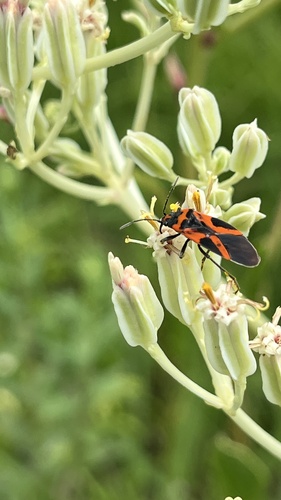
The False Milkweed Bug is a small, colorful insect that loves to munch on milkweed plants. They have a bright red and black pattern that makes them look like little superheroes in the garden!
Habitat: Grasslands
The False Milkweed Bug is a striking insect with a black body boldly marked with red or orange patches. It has a distinctive black "X" or cross pattern on its back, differentiating it from the true milkweed bug, which has more blocky black and orange patterns.
Category
InsectsRarity
Common
Danger
1/5 · Very low
Snaps
22
False Milkweed Bugs have a long "beak" to sip juices from various plant seeds.
Its bright colors trick predators into thinking it's a dangerous, toxic bug!
These bugs often gather in sunny spots, warming up together like tiny sunbathers.
Unlike its namesake, it avoids milkweed plants, preferring tasty seeds instead.
False Milkweed Bug has bright red and black patterns that warn predators it might taste bad, even if it doesn't.
False Milkweed Bug can pierce tough seeds with its special mouthpart to drink their nutritious fluids.
False Milkweed Bug has wings that help it quickly escape danger and find new plants for food.
This bug sips liquid from the seeds of various plants, especially sunflowers.
Social animals live in organized groups, cooperating for survival benefits such as foraging, defense, and raising offspring.
Colorful describes organisms or objects displaying a wide range of bright and distinct colors.
Grassland habitats are terrestrial biomes dominated by grasses and herbaceous plants, supporting a variety of grazing animals.
This trait characterizes organisms whose diet consists entirely or primarily of plant material.

Describes plants that are particularly attractive and beneficial to a wide range of pollinating organisms.

Diurnal animals are primarily active during daylight hours, typically resting or sleeping at night.

Describes a species whose presence and role have a disproportionately large effect on its environment.

Describes organisms that transfer pollen, enabling the fertilization and reproduction of plants.
No aliases listed yet.
Danger
1/5 · Very low
These bugs are not harmful, but it's always best to look and not touch.
The easiest way to identify False Milkweed Bug is to use the Snappit nature identifier app.
10-12 mm
10-12 mm
30-60 days
This bug sips liquid from the seeds of various plants, especially sunflowers.
Grasslands
Foraging
6
Zoom in to split clusters and explore where this object has been snapped.
Jun 8, 2026
Shaw Nature ReservePhoto attribution
(c) diana schwartz, some rights reserved (CC BY)
License: CC BY 4.0 ↗
Image may be shown cropped inside the card frame.

Missouri, US
You might spot Common Eastern Bumble Bee and Brown-Belted Bumble Bee.
View guide →

North Carolina, US
You might spot American Robin and Eastern Gray Squirrel.
View guide →

New Jersey, US
You might spot Common Mugwort and White-Tailed Deer.
View guide →

New Jersey, US
You might spot Monarch, Great Blue Heron, and American Robin.
View guide →

Virginia, US
You might spot Asian Lady Beetle, Spotted Lanternfly, and Christmas Fern.
View guide →

Illinois, US
You might spot Northern Cardinal, Eastern Pondhawk, and Common Watersnake.
View guide →
Take the discovery with you
Snap it with Snappit to identify it, learn what makes it special, and add the discovery to your collection.








.jpg&width=800)


