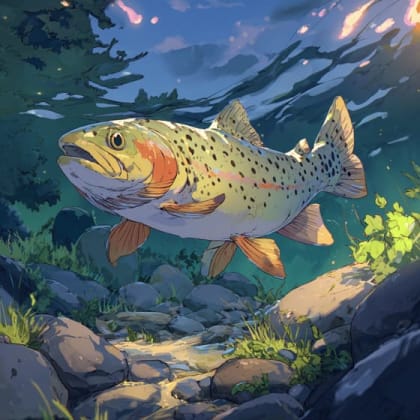
Ide
Leuciscus idus
Ide are playful fish with a shiny body that love to swim in schools. They are curious and often explore their watery homes.
Habitat: Rivers and lakes
The Ide has a sleek, silvery body, often darker on its back with a lighter belly. Its fins, especially the anal and caudal, frequently display a striking reddish-orange hue, making it visually distinct from duller river fish.
Category
FishRarity
Rare
Danger
2/5 · Low
Snaps
Be the first to snap!
Baby Ide eat tiny creatures; adults add plants and small fish to their diet!
Ide are excellent jumpers, leaping from water to catch flying insects!
Ide travel in large schools, creating a shimmering 'silver parade' in rivers!
The golden Ide, Orfe, is a popular fish for garden ponds globally!
Ide can thrive in very cold waters, even under ice, because of their strong physiological adaptation to low temperatures.
Ide has a sensitive lateral line system that helps them detect tiny water vibrations from prey or predators, even in murky water.
Ide can switch their diet easily between insects, plants, and small fish, which helps them survive when food sources change.
Ide are adaptable eaters, munching on insects, plants, and sometimes smaller fish.
Age differences: Young Ide primarily eat zooplankton and insect larvae, while adults consume larger insects, crustaceans, plant matter, and small fish.
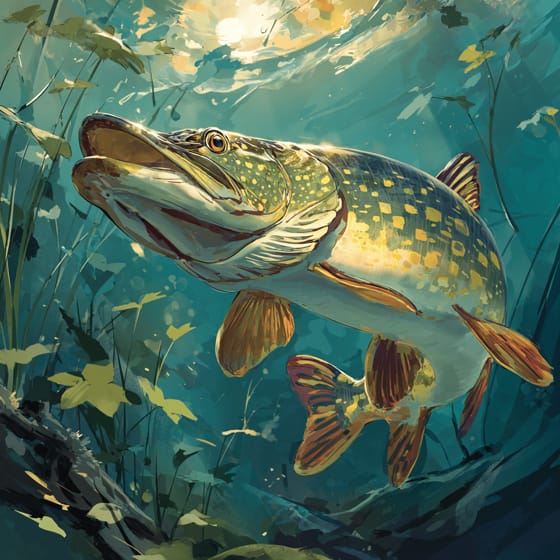
Esox lucius
Pike are major predators of Ide in many freshwater systems.
Lutra lutra
Otters are skilled hunters that prey on fish like Ide.
.jpg&width=800)
Ardea cinerea
Herons stalk shallow waters, preying on Ide and other fish.
Chironomus plumosus
Ide larvae and juveniles feed on these common midge larvae.
Wildlife encompasses all undomesticated animal and plant life existing in their natural habitats.
Social animals live in organized groups, cooperating for survival benefits such as foraging, defense, and raising offspring.
This trait identifies organisms whose diet includes both plant and animal matter.
Colorful describes organisms or objects displaying a wide range of bright and distinct colors.

Freshwater habitats include non-saline aquatic environments such as rivers, lakes, ponds, and wetlands, vital for numerous species.

Aquatic habitats encompass environments where organisms live predominantly in water, including oceans, rivers, lakes, and wetlands.
Danger
2/5 · Low
Watch quietly from a distance and never try to feed or chase wild animals.
The easiest way to identify Ide is to use the Snappit nature identifier app.
30-90 cm
0.5-8 kg
15-25 years
Ide are adaptable eaters, munching on insects, plants, and sometimes smaller fish.
20 km/h
Rivers and lakes
Foraging
Zoom in to split clusters and explore where this object has been snapped.
Recent snaps will appear here as new observations are added.

California, US
You might spot Jaguar, Varecia Variegata Subcincta, and Red Ruffed Lemur.
View guide →

California, US
You might spot Giant Anteaters and Black-and-Gold Howler Monkey.
View guide →

Alaska, US
You might spot Steller Sea Lion, Harbor Seal, and Tufted Puffin.
View guide →

Florida, US
You might spot Great White Shark, Spotted Eagle Ray, and Sea Turtle.
View guide →
.jpg&width=800)
Colorado, US
You might spot Reticulated Giraffe, African Penguin, and African Elephant.
View guide →

US
You might spot Bottlenose Dolphin and Sea Lion.
View guide →
Take the discovery with you
Snap it with Snappit to identify it, learn what makes it special, and add the discovery to your collection.