





Mountain Misery
Chamaebatia foliolosa
Mountain Misery is a small shrub that grows in rocky places. It has soft, green leaves and pretty white flowers that bloom in the spring. This plant is special because it can survive in tough mountain conditions!
Habitat: Mountain regions
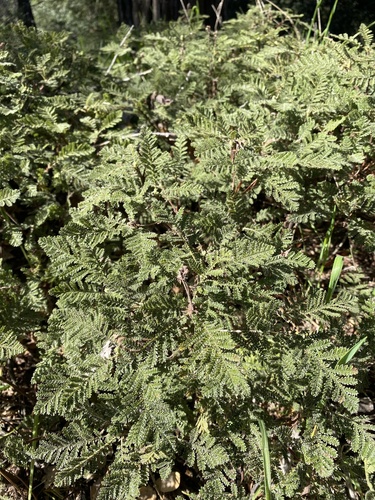
The Mountain Misery is a low-growing, mat-forming shrub with deeply divided, fern-like green leaves. Its foliage is notably sticky and resinous, often appearing somewhat glossy. Small, white, five-petaled flowers bloom above the dense mats, adding a bright contrast to its darker leaves.
Category
PlantsRarity
Common
Danger
2/5 · Low
Snaps
12
If you brush against Mountain Misery, its pungent, resinous scent will often cling to your clothes for hours!
It got its name 'Mountain Misery' because its extremely sticky leaves make hiking through it quite challenging!
Its unique, deeply divided leaves resemble tiny green ferns, even though it's not actually a fern!
Native Americans traditionally used the plant's leaves externally for various medicinal poultices and washes.
Mountain Misery can quickly regrow from its robust root crown after a wildfire, making it highly fire-adapted.
It has a deep taproot that helps it reach water far below ground, allowing it to thrive in very dry areas.

Bombus melanopygus
Visits its white flowers for nectar and pollen.
Apis mellifera
Helps spread pollen between Mountain Misery plants.
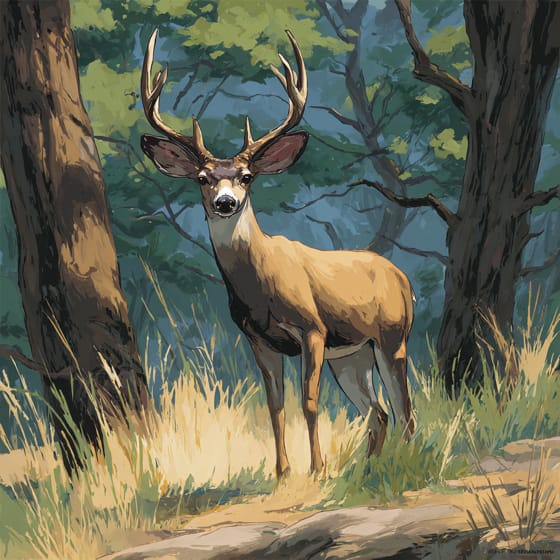
Odocoileus hemionus
May browse on its leaves, especially new growth.
.jpg&width=800)
Pipilo maculatus
Nests or finds cover within its dense, spreading mats.
Aromatic plants produce and emit fragrant volatile organic compounds, often for defense or to attract pollinators.
Flowering plants are any plants that produce flowers as part of their reproductive cycle.
A shrub is a woody plant smaller than a tree, typically with multiple stems branching from or near the ground.
Spring blooming plants produce their flowers during the spring season, often signifying the end of winter and the start of new growth.

Cold hardy plants are able to withstand low temperatures and freezing conditions without significant damage.

Fragrant flowers emit a pleasant aroma, often to attract pollinators or for defense.

Drought-tolerant plants can survive and flourish in conditions with limited water availability.

Describes plants that are particularly attractive and beneficial to a wide range of pollinating organisms.

This habitat trait identifies species found in mountainous regions, characterized by high elevation, steep slopes, and varying climate zones.
No aliases listed yet.
Danger
2/5 · Low
Do not eat any part of this plant, as it can make you feel sick.
The easiest way to identify Mountain Misery is to use the Snappit nature identifier app.
10-30 cm
30-90 cm
1-2 cm
Late spring to summer
No
Mild
Perennial
Zoom in to split clusters and explore where this object has been snapped.
Mar 14, 2026
Black Mountain GrovePhoto attribution
no rights reserved
License: CC0 1.0 ↗
Image may be shown cropped inside the card frame.

California, US
You might spot Sequoia, California Newt, and Pacific Dogwood.
View guide →
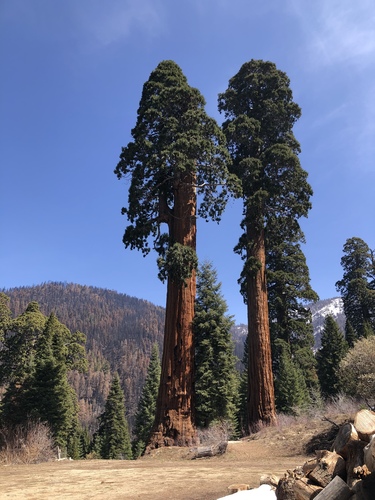
California, US
You might spot Sequoia, Mountain Misery, and Black Bear.
View guide →

California, US
You might spot Sequoia, California Incense-Cedar, and White Fir.
View guide →

California, US
You might spot Yellow Star-Tulip and Mountain Misery.
View guide →

California, US
You might spot Sequoia, Mule Deer, and Black Bear.
View guide →

California, US
You might spot Sequoia, Mule Deer, and Black Bear.
View guide →
Take the discovery with you
Snap it with Snappit to identify it, learn what makes it special, and add the discovery to your collection.








.jpg&width=800)


_001.jpg&width=800)




