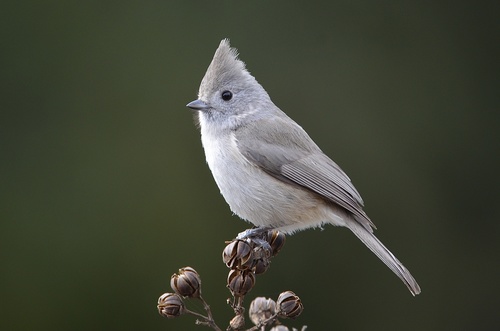


Oak Titmouse
baeolophus inornatus
The Oak Titmouse is a lively, charismatic little songbird characteristic of the oak woodlands along the Pacific Coast of North America. Renowned for their energetic foraging and constant vocalizations, these small birds are a staple presence wherever mature oak trees are found. They form strong, lifelong pair bonds, fiercely defending their established territories year-round rather than migrating. What they lack in bright plumage, they make up for in personality, often seen hanging upside down from terminal branches or flitting actively through the canopy. Their reliance on tree cavities for nesting ties their fate closely to the health of old-growth oak ecosystems, making them an excellent indicator species for these habitats.
Habitat: Found primarily in warm, dry oak or pine-oak woodlands across the Pacific slope of North America.
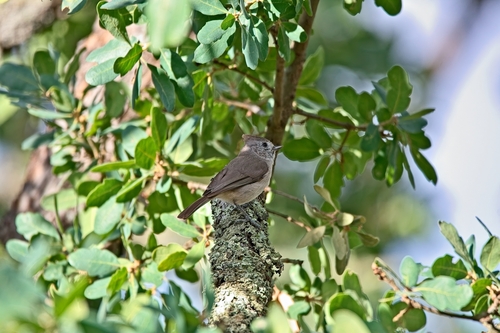
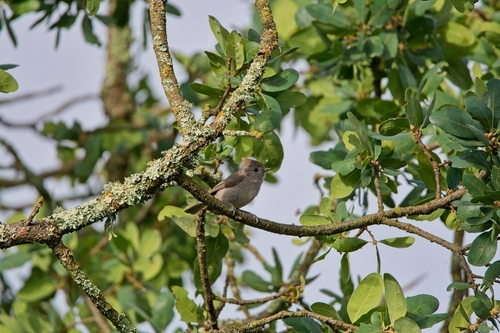
The Oak Titmouse is a small, relatively unadorned bird characterized by its plain grayish-brown plumage that blends seamlessly into the bark and shadows of oak trees. It sports a prominent, short crest on its head that it can raise or lower depending on its mood. Its face is unmarked, with distinct dark eyes and a short, stout black bill well-suited for cracking seeds and gleaning insects. Measuring roughly 13 to 16 centimeters in length, both males and females look identical, lacking the bold stripes or bright colors seen in many other small woodland birds.
Category
BirdsRarity
Common
Danger
1/5 · Very low
Snaps
4
Because they cannot excavate their own nesting cavities, they rely entirely on natural holes in trees or abandoned woodpecker nests to raise their young.
Oak Titmice mate for life and remain on their breeding territories year-round, aggressively defending their home turf even in the dead of winter.
To stay warm during freezing winter nights, these small birds roost alone in snug tree cavities, dramatically puffing up their feathers for insulation.
Until 1996, the Oak Titmouse and the closely related Juniper Titmouse were considered a single species known simply as the 'Plain Titmouse'.
Possesses highly adaptable feet and legs, allowing it to hang upside down from the tips of branches to glean hidden insects.
Actively stores seeds, acorns, and nuts in bark crevices or patches of lichen, ensuring a stable food supply during harsh winter months.
Utilizes a diverse repertoire of calls, including a harsh scolding 'tsicka-dee' and rhythmic whistles, to coordinate with its lifelong mate and defend territory.
Their diet consists heavily of insects and spiders during the warmer breeding season, shifting toward acorns, seeds, and berries during the fall and winter.
Age differences: Nestlings are fed an exclusive diet of soft-bodied insects, particularly caterpillars, for optimal protein intake and growth.

Quercus agrifolia
Relies heavily on these trees for nesting cavities, acorns, and the diverse insect life they support.

Megascops kennicottii
Preyed upon by small avian predators, particularly during the vulnerable nesting season.
.jpg&width=800)
Thryomanes bewickii
Competes intensely for limited natural tree cavities required for nesting.
No trait badges are assigned for this object yet.
No aliases listed yet.
Collections for this object will appear here as more themes are added.
Danger
1/5 · Very low
No special safety notes yet.
The easiest way to identify Oak Titmouse is to use the Snappit nature identifier app.
13-16 cm
23-25 cm
0.014-0.022 kg
3-9 years
Their diet consists heavily of insects and spiders during the warmer breeding season, shifting toward acorns, seeds, and berries during the fall and winter.
Found primarily in warm, dry oak or pine-oak woodlands across the Pacific slope of North America.
Foraging
Zoom in to split clusters and explore where this object has been snapped.
Jun 3, 2026
Sonoma PlazaPhoto attribution
(c) Daveozric, some rights reserved (CC BY)
License: CC BY 4.0 ↗
Image may be shown cropped inside the card frame.
Jun 3, 2026
Sonoma PlazaPhoto attribution
(c) Daveozric, some rights reserved (CC BY)
License: CC BY 4.0 ↗
Image may be shown cropped inside the card frame.

California, US
You might spot Acorn Woodpecker and Western Fence Lizard.
View guide →

California, US
You might spot Mule Deer, Turkey, and Duck.
View guide →

California, US
You might spot Western Fence Lizard and California Poppy.
View guide →

California, US
You might spot Horse-Fly Carpenter Bee and Anna's Hummingbird.
View guide →

California, US
You might spot Horse-Fly Carpenter Bee and Anna's Hummingbird.
View guide →

California, US
You might spot Horse-Fly Carpenter Bee and Anna's Hummingbird.
View guide →
Take the discovery with you
Snap it with Snappit to identify it, learn what makes it special, and add the discovery to your collection.








.jpg&width=800)









