





Orange Sulphur
Colias eurytheme
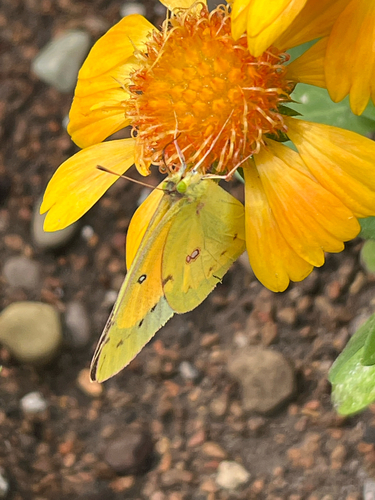
The Orange Sulphur is a bright butterfly with beautiful orange wings. It flutters around gardens and fields, bringing joy to everyone who sees it!
Habitat: Grasslands
The Orange Sulphur has vibrant orange-yellow upperwings with distinct dark borders, especially noticeable on males. Females can be lighter orange or even white, often with more smudgy dark markings. A small black spot is typically visible on each forewing.
Category
InsectsRarity
Common
Danger
1/5 · Very low
Snaps
28
If you see a butterfly sipping from a mud puddle, it's actually getting vital minerals like a tiny juice box!
In warm places, the Orange Sulphur can have up to five generations of butterflies hatch in just one year!
Some female Orange Sulphurs are genetically bright white instead of orange, making them look totally different!
They are sometimes called "Alfalfa Butterflies" because their caterpillars love to munch on alfalfa plants!
Orange Sulphur can fly surprisingly fast, up to 25 km/h, which helps them escape predators and find mates quickly.
Orange Sulphur has a special genetic trait where some females are bright white instead of orange, which helps them blend in.
Orange Sulphur can sunbathe to warm up its flight muscles, which helps it become active and fly quickly on cool mornings.
Caterpillars munch on leaves, while adults sip sweet nectar from various flowers!
Age differences: Larvae (caterpillars) eat plant leaves, while adults drink nectar from flowers.
Colorful describes organisms or objects displaying a wide range of bright and distinct colors.
Grassland habitats are terrestrial biomes dominated by grasses and herbaceous plants, supporting a variety of grazing animals.
This trait characterizes organisms whose diet consists entirely or primarily of plant material.
Describes plants that are particularly attractive and beneficial to a wide range of pollinating organisms.

Diurnal animals are primarily active during daylight hours, typically resting or sleeping at night.

Migratory animals undertake seasonal movements from one region to another, typically in response to changes in climate or food availability.

Describes organisms that transfer pollen, enabling the fertilization and reproduction of plants.
Danger
1/5 · Very low
It's best to watch butterflies from a distance and not try to catch them.
The easiest way to identify Orange Sulphur is to use the Snappit nature identifier app.
35-60 mm
15-25 mm
10-20 days
25 km/h
Caterpillars munch on leaves, while adults sip sweet nectar from various flowers!
Grasslands
Foraging
Zoom in to split clusters and explore where this object has been snapped.
Jun 13, 2026
Missouri Botanical GardenPhoto attribution
(c) Lena Struwe, some rights reserved (CC BY-SA)
License: CC BY-SA 4.0 ↗
Image may be shown cropped inside the card frame.

Virginia, US
You might spot Eastern Box Turtle and White-Tailed Deer.
View guide →

Pennsylvania, US
You might spot American Robin, Red-Winged Blackbird, and Lesser Celandine.
View guide →

Iowa, US
You might spot Common Eastern Bumble Bee and Eastern Cottontail.
View guide →

Arkansas, US
You might spot Pear-Shaped Puffball and American Beautyberry.
View guide →

California, US
You might spot White Globe Lily, Rose Campion, and Pipevine Swallowtail.
View guide →

Iowa, US
You might spot Common Eastern Bumble Bee and North American Luna Moth.
View guide →
Take the discovery with you
Snap it with Snappit to identify it, learn what makes it special, and add the discovery to your collection.






.jpg&width=800)


.jpg&width=800)



