





Spanish moss
Tillandsia usneoides
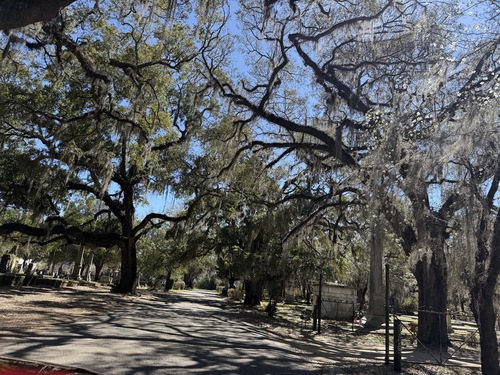
Spanish moss is a beautiful, gray-green plant that hangs from trees like soft curtains. It loves warm, humid places and can be found swaying gently in the breeze.
Habitat: Coastal areas
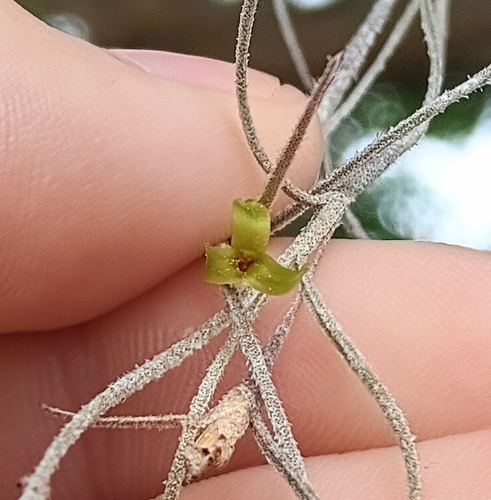
The Spanish moss has a striking silvery-gray, hair-like appearance, forming long, draping strands from tree branches. Its narrow, scaly leaves are covered in tiny silver scales, giving it a soft, fuzzy texture that easily distinguishes it from true mosses.
Category
PlantsRarity
Common
Danger
1/5 · Very low
Snaps
40
Before synthetic materials, people used tons of Spanish moss to stuff furniture, mattresses, and even car seats!
It's an epiphyte, meaning it hangs on trees for support but doesn't take their food or water!
Its tiny flowers are hard to spot, but they release a sweet perfume, especially noticeable in the evenings!
Some tiny creatures, like the Spanish moss mite, live only inside its strands and nowhere else!
Spanish moss can absorb all its water and nutrients directly from humid air and rain, meaning it doesn't need soil to grow!
Its tiny silvery scales help reflect sunlight, protecting it from intense sun and reducing water loss in hot environments.
Its long, tangled strands provide excellent shelter and nesting material for many small animals and birds.

Setophaga dominica
Nests exclusively within its hanging strands.
Lasiurus seminolus
Roosts in its dense, camouflaged clumps.
Hyla cinerea
Hides from predators within the moss.

Amblycorypha oblongifolia
Camouflages itself among the strands.
Ornamental plants are cultivated primarily for their aesthetic appeal, enhancing landscapes and gardens with their attractive foliage, flowers, or form.
Describing a plant or anatomical structure that droops or hangs downwards.
Aerial creatures spend a significant portion of their lives airborne, utilizing flight for various activities such as hunting, migration, or nesting.
Evergreen plants retain their foliage throughout the year, never shedding all their leaves at once.

This trait characterizes organisms with an exceptionally long lifespan compared to others of their kind.

Coastal habitats are dynamic environments located along the interface between land and sea, influenced by tides, waves, and saltwater.

Describes a species whose presence and role have a disproportionately large effect on its environment.
Danger
1/5 · Very low
Spanish moss is safe to touch, but don't pull it off trees without asking an adult.
The easiest way to identify Spanish moss is to use the Snappit nature identifier app.
100-600 cm
0.3-0.5 cm
Late_spring_to_early_summer
No
None
Perennial
Wind
Zoom in to split clusters and explore where this object has been snapped.
May 1, 2026
Columbia CanalPhoto attribution
(c) Raven Dandridge, some rights reserved (CC BY)
License: CC BY 4.0 ↗
Image may be shown cropped inside the card frame.
Mar 21, 2025
Icehouse Historic DistrictPhoto attribution
(c) Brandon Corder, some rights reserved (CC BY)
License: CC BY 4.0 ↗
Image may be shown cropped inside the card frame.

South Carolina, US
You might spot American Alligator, Anole, and Great Blue Heron.
View guide →

Georgia, US
You might spot Gulf Fritillary, Anole, and American Beautyberry.
View guide →

Louisiana, US
You might spot Brown Anole, White Ibis, and Duck.
View guide →

South Carolina, US
You might spot Brown Pelican, Boat-Tailed Grackle, and Great Egret.
View guide →

South Carolina, US
You might spot Great Blue Heron, Spanish Moss, and Cahaba Lily.
View guide →

Georgia, US
You might spot Baldcypress, Anole, and American Alligator.
View guide →
Take the discovery with you
Snap it with Snappit to identify it, learn what makes it special, and add the discovery to your collection.









.jpg&width=800)



_001.jpg&width=800)


