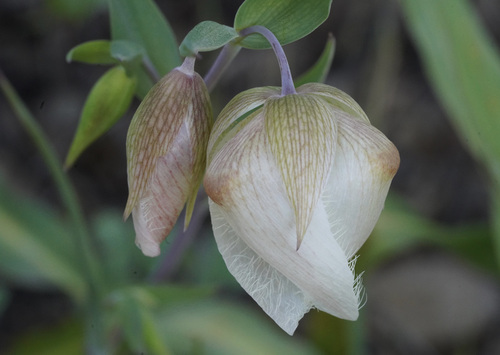


White Globe Lily
calochortus albus
The White Globe Lily (Calochortus albus), also known as the fairy lantern or white globe tulip, is an enchanting wildflower native to the shaded woodlands and brushy slopes of California. Emerging in late winter and blooming throughout spring, this perennial bulbous herb is beloved for its nodding, pearlescent white blossoms that resemble delicate, glowing lanterns suspended in mid-air. Unlike many of its upright cousins in the genus Calochortus, the white globe lily gently bows its head, creating a mystical, woodland aesthetic. Historically, various Indigenous peoples of California utilized the plant's bulbs as a nutritious food source, roasting or boiling them to reveal a sweet, starchy flavor. Today, it remains an iconic find for hikers and nature photographers exploring California's diverse plant communities.
Habitat: Found in shaded oak woodlands, mixed evergreen forests, and rocky, brushy canyons in California.
The White Globe Lily is distinguished by its nodding, spherical to egg-shaped white or pale-pink flowers that hang downward on slender, arching stems. Each flower consists of three outer greenish-white sepals and three large, deeply curved inner petals that overlap to form a closed 'globe' shape, fringed with delicate white hairs along the margins. The plant features long, lance-shaped, grass-like leaves that are glossy green, often drying up by the time the flower fully opens. Stems typically grow between 20 to 80 centimeters tall, often branching to support multiple hanging blossoms.
Category
PlantsRarity
Common
Danger
1/5 · Very low
Snaps
2
Indigenous groups like the Miwok and Ohlone collected the starch-rich bulbs of the lily, which were roasted or boiled as a seasonal food source.
The common name 'fairy lantern' describes how the translucent white petals appear to glow softly when backlit by low spring sunlight.
The scientific name Calochortus is derived from Greek, meaning 'beautiful grass', in reference to the plant's elegant, grass-like leaves.
Utilizes a deep underground bulb to store water and starches, allowing the plant to survive dry California summers in a dormant state.
Its uniquely closed, nodding flower shape protects delicate reproductive organs from harsh wind and rain while creating a warm, sheltered microclimate for pollinating insects.
Produces seeds containing nutrient-rich structures that attract ants, which carry the seeds underground and facilitate seedling germination.
As an autotrophic plant, the White Globe Lily synthesizes its own sugars using sunlight, water, carbon dioxide, and essential nutrients absorbed from the soil.
Bombus vosnesenskii
Feeds on the nectar and pollen of the flowers, acting as the primary pollinator.

Odocoileus hemionus
Occasionally grazes on the stems, leaves, and buds during the spring growth period.
No trait badges are assigned for this object yet.
No aliases listed yet.
Collections for this object will appear here as more themes are added.
Danger
1/5 · Very low
No special safety notes yet.
The easiest way to identify White Globe Lily is to use the Snappit nature identifier app.
20-80 cm
5-15 years
As an autotrophic plant, the White Globe Lily synthesizes its own sugars using sunlight, water, carbon dioxide, and essential nutrients absorbed from the soil.
Found in shaded oak woodlands, mixed evergreen forests, and rocky, brushy canyons in California.
Photosynthesis
Zoom in to split clusters and explore where this object has been snapped.

California, US
You might spot White Globe Lily, Rose Campion, and Pipevine Swallowtail.
View guide →

California, US
You might spot Western Fence Lizard and Pacific Poison Oak.
View guide →

California, US
You might spot Canyon Sunflower, Cardinal Catchfly, and White Globe Lily.
View guide →
California, US
You might spot Mount Diablo Fairy-Lantern and Western Fence Lizard.
View guide →

California, US
You might spot Western Fence Lizard and Pacific Hound's Tongue.
View guide →

California, US
You might spot White Globe Lily, California Buckeye, and Rose Campion.
View guide →
Take the discovery with you
Snap it with Snappit to identify it, learn what makes it special, and add the discovery to your collection.











.jpg&width=800)



_001.jpg&width=800)




