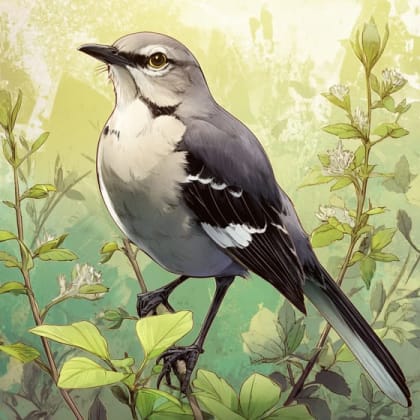





Northern Mockingbird

Fort Concho is a beautifully preserved frontier fort, a window into West Texas history.
Fort Concho is a beautifully preserved frontier fort, a window into West Texas history. This National Historic Landmark allows visitors to step back in time to experience life as it was in a 19th-century U.S. Army outpost. With its impressive collection of original and reconstructed limestone buildings, Fort Concho offers a unique glimpse into the lives of soldiers and civilians who shaped the American West.
Explore over two dozen historic structures, including officers' quarters, barracks, and the unique schoolhouse/chapel, all arranged around a vast parade ground. Engaging exhibits bring history to life, from the stories of the Buffalo Soldiers of the 10th Cavalry to a fascinating collection of frontier army artifacts. Don't miss the Living History Stables, where you might encounter the fort's resident mules. The fort also features rotating exhibits, such as a tribute to the Comanche people with a full-size tipi and authentic tools, and a display on frontier army bands.
Fort Concho isn't just a museum; it's an immersive experience that transports you to a pivotal era of American history. Its dedication to preserving its past, combined with a vibrant schedule of living history events and special programs like Frontier Day and Christmas at Old Fort Concho, makes it a memorable destination for all ages. Whether you're a history enthusiast, a family looking for an educational outing, or simply curious about the frontier, Fort Concho offers a rich and rewarding visit. Eager to name that creature? Identify any animal you find during your visit using the Snappit app.
Established in November 1867 at the confluence of the North and South Concho Rivers, Fort Concho was a vital United States Army installation during the late American Indian Wars. It was strategically located along significant routes like the Butterfield Overland Mail Route and the Goodnight-Loving Trail, serving to protect frontier settlements, patrol West Texas, and quell hostile threats. The fort was built primarily from native limestone, eventually comprising some 40 buildings across 1,600 acres, and supported 400 to 500 military and support staff at its peak. Fort Concho was home to the 4th Cavalry from 1867 to 1875, and famously, the "Buffalo Soldiers" of the 10th Cavalry from 1875 to 1882. These troops participated in significant campaigns such as Mackenzie's 1872 campaign, the Red River War in 1874, and the Victorio Campaign of 1879–1880. The fort was abandoned in June 1889, after nearly 22 years of active service, with many of its buildings repurposed. Efforts to preserve and restore Fort Concho began in the early 1900s, leading to the founding of the Fort Concho Museum in 1929. It was designated a National Historic Landmark on July 4, 1961, and is now owned and operated by the City of San Angelo.
Take a self-guided tour with a provided map, attend a guided tour, or immerse yourself in a living history event. Explore the numerous historic buildings, view the extensive museum collections, and walk the expansive parade ground.
Summer: Can be hot in Texas; dress accordingly. Water and shade are important. Check for special summer events like National Cowboy Day.
Fall & Spring: Generally pleasant weather, ideal for outdoor exploration. Many festivals and speaker series often occur during these seasons.
Winter: Cooler temperatures make walking the grounds comfortable. Don't miss "Christmas at Old Fort Concho" for a festive historical experience.
While some areas are navigable by wheelchairs, the fort grounds are primarily gravel and not fully ADA-approved for wheelchairs. Service animals are welcome in all fort tour buildings and the visitor center.
Explore the command center of the fort, including rooms remodeled to appear as they would have during its military career.
Step into the past in the restored officers' residences, such as Officer's Quarters 1, which served as the commanding officer's home, and Officer's Quarters 6, a living history exhibit.
Barracks 1 houses the visitor center, while Barracks 2 displays wagons and replica artillery pieces, offering insight into soldier life. Barracks 5 and 6 are also living history spaces.
The fort's final permanent structure, uniquely designed and used for both education and worship.
Each card links to a full Explore page with photos, traits, and fun facts.
Start with the big picture, then zoom in to explore individual wildlife observations around this place.
Wear comfortable shoes suitable for walking on gravel paths and uneven terrain.
Start your visit at Barracks 1, which serves as the visitor center, to pick up a map and get instructions for your self-guided tour.
Check the Fort Concho website for a schedule of special events, living history demonstrations, or reenactments to enhance your visit.
Bring water, especially during warmer months, as much of the exploration is outdoors.
Photography is generally welcome for personal use; however, non-flash photography is requested inside exhibit buildings.
Leashed pets are welcome on the grounds but should remain outside of tour buildings. Service animals are permitted in all buildings.
Aug 2, 2024
Photo attribution
(c) Brayden TNG, some rights reserved (CC BY)
License: CC BY 4.0 ↗
Image may be shown cropped inside the card frame.
Jun 2, 2026
Jun 1, 2026
May 29, 2026
May 28, 2026

Maryland, US
You might spot White-Tailed Deer and Eastern Gray Squirrel.
View guide →
.jpg)
District of Columbia, US
You might spot Eastern Gray Squirrel, Duck, and House Sparrow.
View guide →

Illinois, US
You might spot American Robin, Canada Goose, and House Sparrow.
View guide →

Virginia, US
You might spot Spotted Lanternfly and Northern Cardinal.
View guide →
Take the discovery with you
Identify the wildlife you spot, learn as you go, and keep a collection of the adventure.