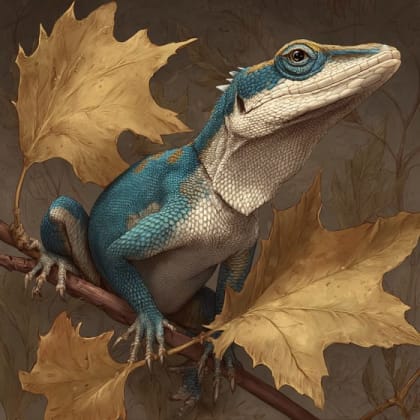





Anole

Fort Frederica National Monument preserves a pivotal chapter in British colonial history on St.
Fort Frederica National Monument preserves a pivotal chapter in British colonial history on St. Simons Island, Georgia. This site protects the archaeological remnants of an 18th-century fort and town, established by James Oglethorpe to defend Georgia's southern frontier against Spanish expansion. It stands as a testament to the struggle for empire and the daily lives of those who built a new world.
Visitors can explore the archaeological ruins of the fort and the expansive town site, where the original street grid and foundations of homes and barracks are still visible. Many structures were built using "tabby," a unique colonial concrete made from oyster shells, lime, sand, and water, offering a tangible connection to the past. The grounds are further enhanced by magnificent, moss-draped live oak trees, contributing to the site's evocative atmosphere, and the Visitor Center features exhibits with excavated artifacts and an aerial model of the town, providing essential historical context.
Fort Frederica National Monument offers more than just historical ruins; it provides an engaging experience to visualize colonial life and appreciate the natural beauty of the Georgia coast. Whether strolling along the former Broad Street, observing the Frederica River, or participating in ranger-led programs, the monument invites contemplation of the determination and challenges faced by its early inhabitants, making it a memorable and educational destination for all ages. Explore the grounds like a pro—download the Snappit app to instantly identify animals and plants.
Fort Frederica was established in 1736 by James Oglethorpe, the founder of the Georgia colony, with the primary purpose of defending the southern boundary of British colonial territories from potential Spanish attacks originating from Florida. A planned town, also named Frederica, rapidly grew around the fort, eventually housing up to 1,000 residents and becoming a significant military and commercial hub. This strategic outpost played a critical role in the Anglo-Spanish conflict known as the War of Jenkins' Ear. The fort's importance culminated in 1742 when British forces, including those from Fort Frederica, decisively defeated the Spanish at the Battle of Bloody Marsh on St. Simons Island, effectively repelling a major invasion and securing Georgia's future as a British colony. However, once the Spanish threat diminished after a peace treaty in 1748, the garrison was disbanded, leading to the town's economic decline. A devastating fire in 1758 destroyed many buildings, and by 1763, the site was largely abandoned. Decades later, the site was authorized as a National Monument in 1936, and extensive archaeological excavations began in 1947 to uncover and preserve its rich history.
Engage with the exhibits and film at the Visitor Center.
* Take a self-guided stroll through the fort and town archaeological site.
* Join a ranger-led walking tour for deeper insights into the site's history and nature (check schedule at Visitor Center for availability).
* Participate in the Junior Ranger program for children, a unique and award-winning activity.
* Hike the various trails, such as the Yacht Club Trail, Marsh Trail, and Oglethorpe's House Trail, which wind through the maritime forest.
* Enjoy birdwatching, as the park is a beautiful location for observing various bird species.
* Fishing is permitted from the dock located at the southwestern end of the grounds.
Coastal Georgia experiences high heat and humidity during late spring, summer, and early fall, accompanied by biting insects such as sand gnats, ticks, flies, mosquitoes, and chiggers. Visitors should plan to bring insect repellent and stay hydrated during these months. Living history demonstrations by volunteers typically take place on Saturdays from November to March.
The main pathway from the Visitor Center to the fort, roughly a quarter-mile along Broad Street, is flat and mostly covered with grass, making it accessible. For visitors with mobility impairments, golf cart tours can be arranged if staff is available, and a wheelchair is also provided for use. Service animals are permitted in the park.
Start here to gain context from the interpretive exhibits, artifacts, and a 23-minute film on the fort's history. An aerial model of the town helps visualize its past layout.
Explore the remnants of the King's Magazine and barracks, showcasing impressive tabby construction.
Walk along the historic Broad Street, where markers denote the locations and foundations of colonial homes and businesses.
Admire the majestic, moss-draped live oak trees that define the Lowcountry landscape.
Each card links to a full Explore page with photos, traits, and fun facts.
Start with the big picture, then zoom in to explore individual wildlife observations around this place.
Begin at the Visitor Center
Start your visit by watching the park film and exploring the exhibits to gain essential historical context before venturing out onto the grounds.
Come Prepared for Insects
Especially during warmer months (late spring to early fall), bring insect repellent to protect against sand gnats, mosquitoes, ticks, and chiggers.
Wear Comfortable Footwear
The terrain consists of grass and some uneven areas, so comfortable walking shoes are highly recommended for exploring the expansive site.
Stay Hydrated
Coastal Georgia's climate can be hot and humid, so carry water, particularly during extended walks.
Consider Ranger-Led Programs
If available, join a ranger-led tour or program for engaging narratives and deeper historical understanding beyond the self-guided experience.
Visit Bloody Marsh Battle Site
Allocate time to visit the detached Bloody Marsh Battle Site, which provides important context to the military history of Fort Frederica.
Jun 6, 2026
Jun 6, 2026
Jun 6, 2026
Jun 6, 2026
Jun 3, 2026

Maryland, US
You might spot White-Tailed Deer and Eastern Gray Squirrel.
View guide →
.jpg)
District of Columbia, US
You might spot Eastern Gray Squirrel, Duck, and House Sparrow.
View guide →

Illinois, US
You might spot American Robin, Canada Goose, and House Sparrow.
View guide →

Virginia, US
You might spot Spotted Lanternfly and Northern Cardinal.
View guide →
Take the discovery with you
Identify the wildlife you spot, learn as you go, and keep a collection of the adventure.