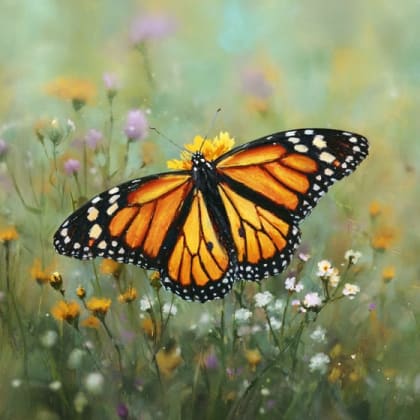





Monarch Butterfly

The William L. Hutcheson Memorial Forest is a living testament to New Jersey's natural heritage. This Rutgers University-managed preserve safeguards one of the last uncut, old-growth forests in the Mid-Atlantic, designated a National Natural Landmark in 1976. Within its 500 acres, visitors can explore a core 65-acre virgin forest, where majestic oaks and hickories have stood undisturbed for centuries, offering a rare glimpse into pre-colonial North American woodlands.
Beyond the ancient trees, the preserve also features diverse habitats, including successional fields and forest wetlands. These areas provide a rich tapestry of flora and fauna, from native grasses and wildflowers that blanket the fields to a remarkable variety of bird species. Keep an eye out for songbirds like Tufted Titmice and Wood Thrushes within the forest canopy, or Indigo Buntings and American Goldfinches flitting through the surrounding fields. The complex interplay of these ecosystems makes Hutcheson a vibrant outdoor laboratory and a haven for biodiversity.
Visiting the Hutcheson Memorial Forest offers a unique opportunity to connect with an enduring natural landscape. It's a place where time slows down, allowing for quiet contemplation amidst towering trees and the subtle symphony of nature. Whether you're captivated by the sheer scale of ancient oaks, intrigued by the ongoing ecological research, or simply seeking a tranquil escape, this forest provides an immersive experience into a truly special corner of New Jersey. Planning to visit? Download the Snappit app to identify the wildlife you spot in real-time.
The area encompassing the William L. Hutcheson Memorial Forest, historically known as Mettler's Woods, has a rich and enduring past. Acquired by Dutch settlers from the Lenape people in 1701, the core 65-acre old-growth forest remained remarkably untouched by logging or tilling for over 250 years, passed down through generations of the same families. In 1955, facing potential sale and development, a dedicated group called the Citizen's Scientific and Historical Committee for the Preservation of Mettler's Woods successfully raised funds, including a significant donation from the United Brotherhood of Carpenters and Joiners of America, to purchase the land. The preserve was subsequently turned over to the care of Rutgers University and The Nature Conservancy and named in honor of William L. Hutcheson, the union's president at the time, recognizing his commitment to natural resource conservation. Since its acquisition, Rutgers University's Department of Ecology, Evolution and Natural Resources has actively managed the site, transforming it into one of the most intensively studied forest tracts globally, with over 250 scientific publications originating from its research. In 1976, its ecological significance was further recognized with its designation as a National Natural Landmark.
Participate in a guided public tour led by Rutgers University faculty volunteers to learn about the forest's ecology, history, and ongoing research. Observe a wide variety of bird species, particularly songbirds in the forest and field areas. Look for indigenous flora like Mayapple and spring ephemerals.
Spring: Abundant wildflowers (e.g., Mayapple, spring ephemerals), active birdlife as many species return for breeding.
Summer: Lush green canopy, continued bird activity, and the old fields covered with wildflowers.
Fall: Migratory birds finding refuge, vibrant fall foliage, and potential sightings of white-tailed deer and other mammals.
Winter: A quieter time, offering a different perspective of the forest structure, and opportunities for spotting resident birds and tracks of mammals.
As of October 2025, an accessible trail design has been proposed and is being implemented to provide a wheelchair-accessible path through goldenrod fields and into the old-growth forest, utilizing compacted gravel and southern yellow pine boardwalks to protect the ecosystem. Previously, general access was limited, making this a significant improvement for inclusivity.
The main highlight is the 65-acre old-growth forest, featuring towering White, Red, and Black Oaks, some over 300 years old. The surrounding successional fields are also significant for their long-term ecological studies and diverse plant life. Look for areas with flowering dogwood and maple-leaved viburnum.
Each card links to a full Explore page with photos, traits, and fun facts.
Start with the big picture, then zoom in to explore individual wildlife observations around this place.
Check Tour Schedule
Always verify the schedule for public tours on the official Rutgers Hutcheson Memorial Forest Center website, as visits are by appointment or scheduled tours only.
Wear Appropriate Footwear
Even with accessible trails, natural areas can be uneven. Sturdy, comfortable walking shoes are recommended.
Bring Binoculars
Birdwatching is a major highlight, so binoculars will enhance your experience, especially for spotting canopy-dwelling birds.
Stay on Designated Paths
To protect the delicate ecosystem and ongoing research, it is crucial to remain on marked trails during your visit.
Be Prepared for Weather
Dress in layers and bring water, as tours can last up to two hours outdoors.
Silence Your Phone
To fully appreciate the sounds of the forest and avoid disturbing wildlife or other visitors, keep your phone on silent.
Jun 4, 2026
Jun 3, 2026
Jun 1, 2026
Jun 1, 2026
Jun 1, 2026

Maryland, US
You might spot White-Tailed Deer and Eastern Gray Squirrel.
View guide →
.jpg)
District of Columbia, US
You might spot Eastern Gray Squirrel, Duck, and House Sparrow.
View guide →

Illinois, US
You might spot American Robin, Canada Goose, and House Sparrow.
View guide →

Virginia, US
You might spot Spotted Lanternfly and Northern Cardinal.
View guide →
Take the discovery with you
Identify the wildlife you spot, learn as you go, and keep a collection of the adventure.














_-_Pollen%C3%A7a%2C_Spain_2022-04-15.jpg&width=800)