





apricot mallow
Sphaeralcea ambigua
Apricot mallow is a bright and cheerful flower that loves to grow in sunny places. Its lovely orange and peach colors attract butterflies and bees, making gardens even more beautiful!
Habitat: Desert
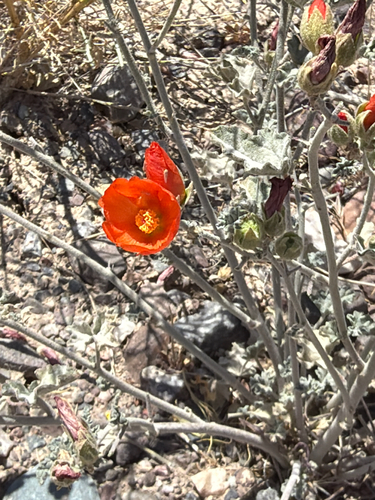
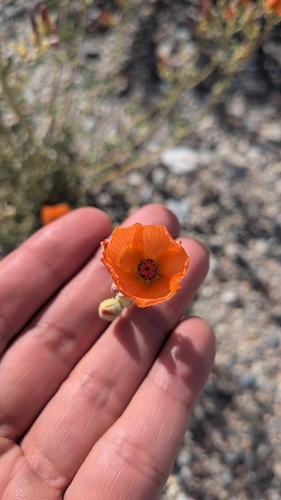
The apricot mallow has vibrant, cup-shaped flowers in shades of orange to peach, often with crinkled petals. Its soft, lobed leaves are covered in fine, star-shaped hairs, giving it a slightly fuzzy appearance, which helps distinguish it from other mallow species.
Category
PlantsRarity
Common
Danger
1/5 · Very low
Snaps
7
Butterflies flock to its bright orange flowers!
It can survive scorching desert heat!
Its fuzzy leaves feel like velvet!
Native Americans used its roots for medicine.
apricot mallow has deep taproots that help it access water far underground, enabling it to survive harsh desert droughts.
apricot mallow has fuzzy leaves covered in tiny hairs that help it reflect sunlight, protecting itself from intense desert heat.
apricot mallow can produce many seeds that easily disperse and sprout, helping it reproduce widely in its environment.
Flowering plants are any plants that produce flowers as part of their reproductive cycle.
A shrub is a woody plant smaller than a tree, typically with multiple stems branching from or near the ground.
Spring blooming plants produce their flowers during the spring season, often signifying the end of winter and the start of new growth.
Summer blooming plants produce their flowers during the summer season, often providing vibrant color when many other plants have finished.

Drought-tolerant plants can survive and flourish in conditions with limited water availability.

Colorful describes organisms or objects displaying a wide range of bright and distinct colors.

Describes plants that are particularly attractive and beneficial to a wide range of pollinating organisms.

Desert habitats are arid regions characterized by extremely low precipitation and often extreme temperatures, supporting specialized flora and fauna.
No aliases listed yet.
Danger
1/5 · Very low
Always look but don't touch flowers without asking an adult.
The easiest way to identify apricot mallow is to use the Snappit nature identifier app.
30-100 cm
30-90 cm
2.5-5 cm
Spring to Fall
Yes
None
Perennial
Zoom in to split clusters and explore where this object has been snapped.
May 25, 2026
SkidooPhoto attribution
(c) Aaron Liston, some rights reserved (CC BY)
License: CC BY 4.0 ↗
Image may be shown cropped inside the card frame.
Mar 27, 2026
SkidooPhoto attribution
(c) dsiripoonsup, some rights reserved (CC BY)
License: CC BY 4.0 ↗
Image may be shown cropped inside the card frame.

California, US
You might spot Western Fence Lizard, Eastern Fox Squirrel, and Duck.
View guide →

California, US
You might spot Frémont's Phacelia and Devil's Spineflower.
View guide →

Arizona, US
You might spot Golden Eagle, Black Bear, and Cougar.
View guide →

California, US
You might spot Giraffes, African Lion, and Tiger.
View guide →

Nevada, US
You might spot Western Joshua Tree, Donkey, and Saltlover.
View guide →

California, US
You might spot Desert Paintbrush and Desert Milkweed.
View guide →
Take the discovery with you
Snap it with Snappit to identify it, learn what makes it special, and add the discovery to your collection.










.jpg&width=800)



_001.jpg&width=800)




