





Bicolored Striped Sweat Bee
Agapostemon virescens
The Bicolored Striped Sweat Bee is a small, shiny bee with beautiful green and black stripes. They love to buzz around flowers, helping them grow by spreading pollen.
Habitat: Urban areas
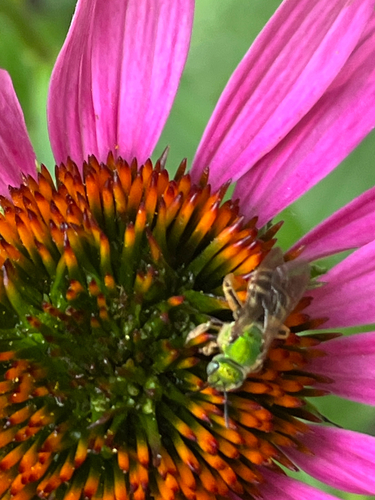
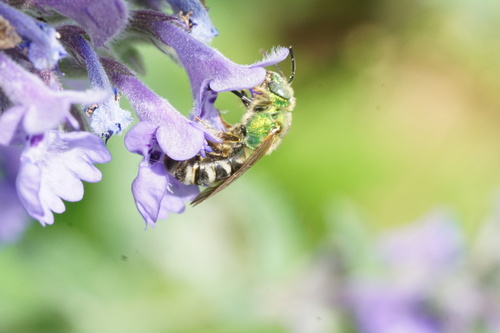
The Bicolored Striped Sweat Bee has a brilliant, iridescent metallic green head and thorax. Its abdomen is distinctly striped with black and bright yellow or pale bands, making it easily distinguishable from other sweat bees. They often appear jewel-like in sunlight.
Category
InsectsRarity
Common
Danger
2/5 · Low
Snaps
50
A female bee carefully packs pollen and nectar into cells for her future babies.
These bees are called 'sweat bees' because they love to drink human sweat for salt!
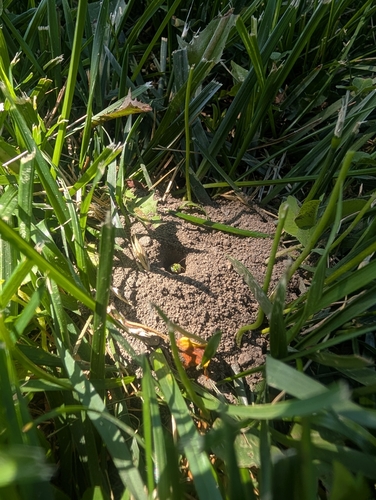
They sometimes share a single burrow entrance, but each bee has its own nest!
Wow, these bees glow like a tiny, emerald jewel in the sunshine!
Bicolored Striped Sweat Bees can 'buzz' pollen free because vibrating their flight muscles helps dislodge stubborn pollen from flowers.
Bicolored Striped Sweat Bees have a specialized, long tongue (proboscis) that helps them reach deep into flowers for nectar.
Bicolored Striped Sweat Bees can dig intricate underground nests because their strong legs and mandibles are perfect for tunneling in soil.
They sip flower nectar for energy and gather pollen to feed their growing larvae, yum!

Helianthus annuus
Carries pollen, helping these big flowers make seeds.
Solidago canadensis
An important pollinator for this common wildflower.
Misumena vatia
Sometimes caught by this camouflaged spider on flowers.
Marked with parallel bands or lines of color.
Social animals live in organized groups, cooperating for survival benefits such as foraging, defense, and raising offspring.
Colorful describes organisms or objects displaying a wide range of bright and distinct colors.
This trait characterizes organisms whose diet consists entirely or primarily of plant material.

Describes plants that are particularly attractive and beneficial to a wide range of pollinating organisms.

Diurnal animals are primarily active during daylight hours, typically resting or sleeping at night.

This habitat trait indicates species that can coexist with humans in urban and suburban environments, utilizing man-made structures and green spaces.

Describes organisms that transfer pollen, enabling the fertilization and reproduction of plants.
No aliases listed yet.
Danger
2/5 · Low
If you see a bee, watch it from a distance and don't try to touch it.
The easiest way to identify Bicolored Striped Sweat Bee is to use the Snappit nature identifier app.
10-24 mm
7-12 mm
30-60 days
18 km/h
They sip flower nectar for energy and gather pollen to feed their growing larvae, yum!
Urban areas
Foraging
Zoom in to split clusters and explore where this object has been snapped.
Jun 19, 2026
Duke GardensPhoto attribution
(c) Natalie Lemanski, some rights reserved (CC BY-SA)
License: CC BY-SA 4.0 ↗
Image may be shown cropped inside the card frame.
Jun 5, 2026
Wesleyan GrovePhoto attribution
(c) Matt Pelikan, some rights reserved (CC BY)
License: CC BY 4.0 ↗
Image may be shown cropped inside the card frame.
Jun 3, 2026
National AviaryPhoto attribution
no rights reserved
License: CC0 1.0 ↗
Image may be shown cropped inside the card frame.

Ohio, US
You might spot Eastern Fox Squirrel and Spotted Lanternfly.
View guide →

Tennessee, US
You might spot House Sparrow, Northern Mockingbird, and Gulf Fritillary.
View guide →

Missouri, US
You might spot Common Eastern Bumble Bee and Brown-Belted Bumble Bee.
View guide →

Michigan, US
You might spot Monarch, Canada Goose, and Eastern Gray Squirrel.
View guide →

Michigan, US
You might spot Monarch, Canada Goose, and Eastern Gray Squirrel.
View guide →

Massachusetts, US
You might spot Common Eastern Bumble Bee and Asian Lady Beetle.
View guide →
Take the discovery with you
Snap it with Snappit to identify it, learn what makes it special, and add the discovery to your collection.







.jpg&width=800)



