





Bullock's Oriole
Icterus bullockii
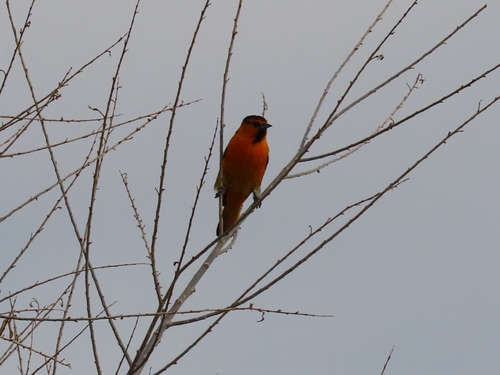
Bullock's Oriole is a bright yellow and black bird that loves to sing! They build beautiful hanging nests and can often be seen in gardens and parks, especially during spring and summer.
Habitat: Urban areas, gardens, and woodlands
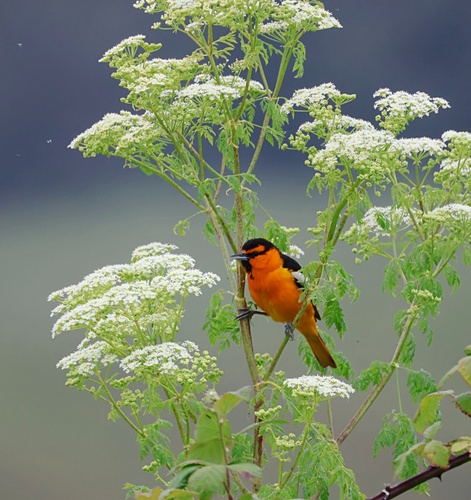
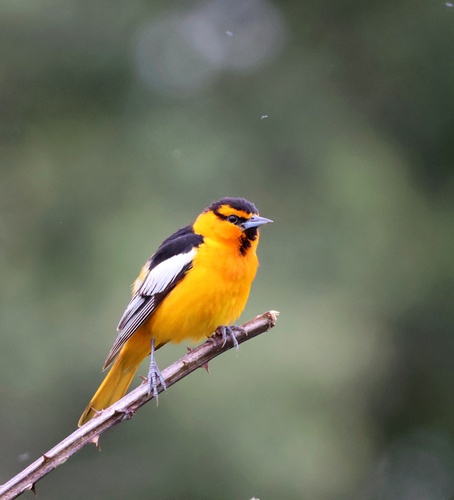
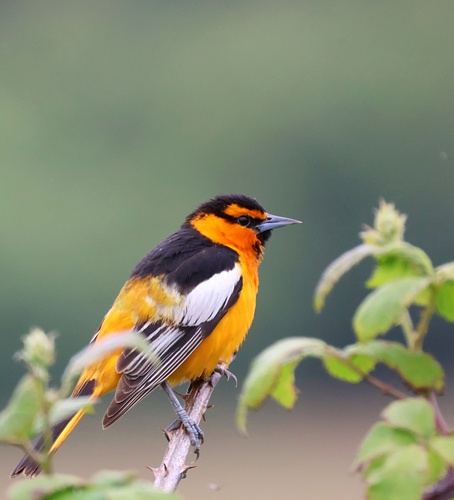
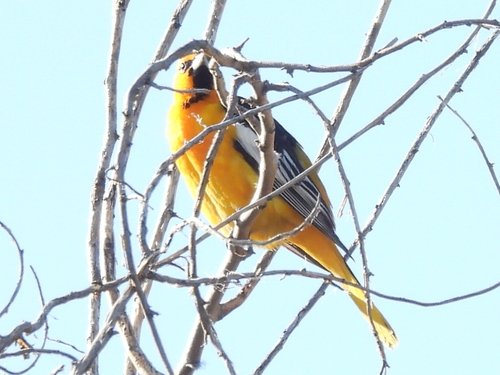
The Bullock's Oriole has a striking appearance with its fiery orange body, black back, and white wing bars. Males show a distinctive black line through the eye and throat, contrasting with their bright orange head. Females are duller yellow with less black.
Category
BirdsRarity
Common
Danger
1/5 · Very low
Snaps
23
Males sing beautiful, whistled songs to attract a mate.
Orioles can hang upside down to reach insects in tricky spots!
Their nests are often made of hair, plant fibers, and even string!
They sometimes drink from hummingbird feeders for a sugary treat.
Bullock's Oriole can construct elaborate hanging nests because of their strong, slender beaks and weaving skills.
Bullock's Oriole has a specialized tongue that helps them sip sweet nectar from deep inside flowers.
Bullock's Oriole can expertly probe bark and leaves because their sharp beaks are perfect for finding hidden insects.
These colorful birds love to snack on sweet fruits, nectar, and many different kinds of insects.
Feathered describes animals, primarily birds, possessing a covering of feathers.
Social animals live in organized groups, cooperating for survival benefits such as foraging, defense, and raising offspring.
This trait identifies organisms whose diet includes both plant and animal matter.
Singing animals produce complex vocalizations, often for purposes of attracting mates, defending territory, or communicating within their species.

Colorful describes organisms or objects displaying a wide range of bright and distinct colors.

Forest habitats are terrestrial environments dominated by dense tree cover, supporting a high diversity of plant and animal life.

Diurnal animals are primarily active during daylight hours, typically resting or sleeping at night.

Migratory animals undertake seasonal movements from one region to another, typically in response to changes in climate or food availability.

This habitat trait indicates species that can coexist with humans in urban and suburban environments, utilizing man-made structures and green spaces.

Describes organisms that transfer pollen, enabling the fertilization and reproduction of plants.
Danger
1/5 · Very low
Enjoy watching birds from a distance and don't try to touch or catch them.
The easiest way to identify Bullock's Oriole is to use the Snappit nature identifier app.
17-22 cm
30-38 cm
0.029-0.043 kg
5-10 years
45 km/h
These colorful birds love to snack on sweet fruits, nectar, and many different kinds of insects.
Urban areas, gardens, and woodlands
Zoom in to split clusters and explore where this object has been snapped.
Jun 12, 2026
Mesilla PlazaPhoto attribution
(c) Suanne Pyle, some rights reserved (CC BY)
License: CC BY 4.0 ↗
Image may be shown cropped inside the card frame.
Jun 3, 2026
Humboldt Botanical GardensPhoto attribution
(c) Eric Austin, some rights reserved (CC BY)
License: CC BY 4.0 ↗
Image may be shown cropped inside the card frame.
Jun 3, 2026
Humboldt Botanical GardensPhoto attribution
(c) Eric Austin, some rights reserved (CC BY)
License: CC BY 4.0 ↗
Image may be shown cropped inside the card frame.
Jun 3, 2026
Humboldt Botanical GardensPhoto attribution
(c) Eric Austin, some rights reserved (CC BY)
License: CC BY 4.0 ↗
Image may be shown cropped inside the card frame.
Jun 1, 2026
Julia Davis ParkPhoto attribution
(c) Sam Kieschnick, some rights reserved (CC BY)
License: CC BY 4.0 ↗
Image may be shown cropped inside the card frame.

Colorado, US
You might spot Common Starlily and Wholeleaf Paintbrush.
View guide →

California, US
You might spot Largemouth Bass and Birdcage Evening Primrose.
View guide →

New Mexico, US
You might spot White-Winged Dove and Silverleaf Nightshade.
View guide →

Oregon, US
You might spot Mule Deer, Song Sparrow, and Northern Yellow Warbler.
View guide →

Oregon, US
You might spot Belding's Ground Squirrel and Yellow-Headed Blackbird.
View guide →
Utah, US
You might spot Great White Shark and Gentoo Penguin.
View guide →
Take the discovery with you
Snap it with Snappit to identify it, learn what makes it special, and add the discovery to your collection.






.jpg&width=800)






