





Lesser Goldfinch
Spinus psaltria
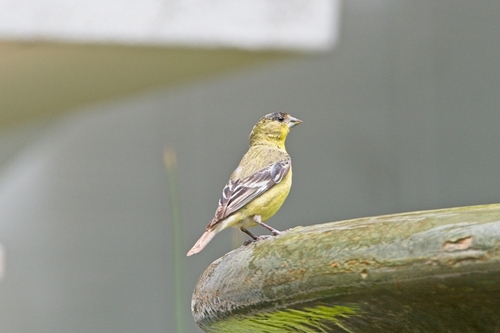
The Lesser Goldfinch is a small, colorful bird that loves to sing. With its bright yellow body and black cap, it can often be seen flitting around in gardens and parks, bringing joy to everyone who spots it.
Habitat: Urban areas
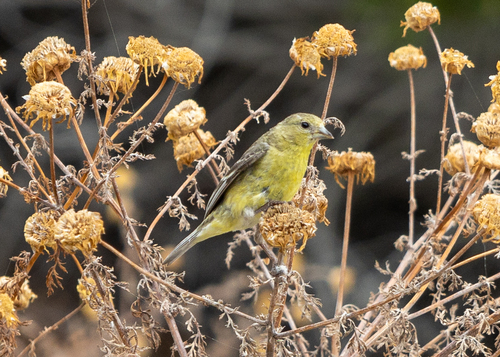
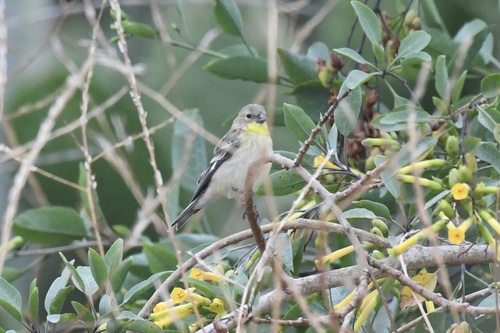
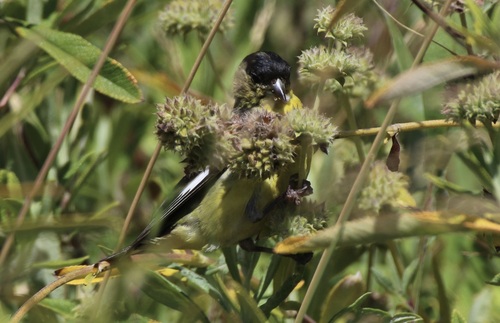
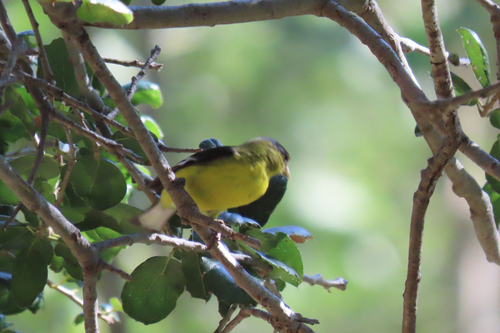
The Lesser Goldfinch is a small songbird, with males sporting a glossy black cap, bright yellow underparts, and black wings adorned with white patches. Females and juveniles are a more subdued olive-yellow. Its distinct black cap sets males apart from other goldfinches.
Category
BirdsRarity
Common
Danger
1/5 · Very low
Snaps
59
Males perform a stunning 'butterfly flight' display while singing to attract a mate!
Their tiny nests sometimes use sticky spider silk for strength!
They can even drink water from dew drops, a tiny drink on leaves!
Unlike many birds, parents feed their babies a special 'seed porridge' for growth!
Lesser Goldfinch can precisely extract tiny seeds from plant heads because of its small, conical beak.
Lesser Goldfinch can hang upside down to reach difficult seeds, a trick that helps them access more food.
Lesser Goldfinch has a complex song that often includes mimicry of other bird calls, enriching its musical repertoire.
Lesser Goldfinch breeds later in the summer, helping them time nesting with the abundance of mature thistle seeds.
These small birds primarily feast on tiny seeds from various plants and weeds.
Age differences: Young are fed a regurgitated 'seed porridge' by parents.
Feathered describes animals, primarily birds, possessing a covering of feathers.
Social animals live in organized groups, cooperating for survival benefits such as foraging, defense, and raising offspring.
Singing animals produce complex vocalizations, often for purposes of attracting mates, defending territory, or communicating within their species.
Colorful describes organisms or objects displaying a wide range of bright and distinct colors.

This trait characterizes organisms whose diet consists entirely or primarily of plant material.

Diurnal animals are primarily active during daylight hours, typically resting or sleeping at night.

This habitat trait indicates species that can coexist with humans in urban and suburban environments, utilizing man-made structures and green spaces.
No aliases listed yet.
Danger
1/5 · Very low
Enjoy watching birds from a distance and don't try to touch them.
The easiest way to identify Lesser Goldfinch is to use the Snappit nature identifier app.
9.5-11.5 cm
16-19 cm
0.008-0.011 kg
4-7 years
45 km/h
These small birds primarily feast on tiny seeds from various plants and weeds.
Urban areas
Zoom in to split clusters and explore where this object has been snapped.
Jun 9, 2026
Sonoma PlazaPhoto attribution
(c) Daveozric, some rights reserved (CC BY)
License: CC BY 4.0 ↗
Image may be shown cropped inside the card frame.
Jun 6, 2026
Venice Canal Historic DistrictPhoto attribution
(c) Roberto Daniel Avila, some rights reserved (CC BY)
License: CC BY 4.0 ↗
Image may be shown cropped inside the card frame.
Jun 6, 2026
Mount EcclesiaPhoto attribution
(c) zr217, some rights reserved (CC BY)
License: CC BY 4.0 ↗
Image may be shown cropped inside the card frame.
Jun 5, 2026
Aquarium of the BayPhoto attribution
(c) Cricket Raspet, some rights reserved (CC BY)
License: CC BY 4.0 ↗
Image may be shown cropped inside the card frame.
Apr 4, 2026
Arroyo Conejo Open SpacePhoto attribution
(c) Kat B, some rights reserved (CC BY)
License: CC BY 4.0 ↗
Image may be shown cropped inside the card frame.

California, US
You might spot Western Fence Lizard and California Brittlebush.
View guide →

New Mexico, US
You might spot Tree Cholla, Colorado Pinyon, and House Finch.
View guide →

California, US
You might spot Redwood, Pacific Trillium, and Evergreen Huckleberry.
View guide →

California, US
You might spot Monarch, Bee, and Anise Swallowtail.
View guide →

Arizona, US
You might spot Northern Cardinal, Engelmann's Hedgehog Cactus, and Queen.
View guide →

Texas, US
You might spot Texas Hedgehog Cactus, Ornate Tree Lizard, and Cactus Wren.
View guide →
Take the discovery with you
Snap it with Snappit to identify it, learn what makes it special, and add the discovery to your collection.






.jpg&width=800)







