Snappit logo
Snappit
Get App
Picos de Europa National Park photo
National ParkSpain, Spain

Picos de Europa National Park

The Covadonga lakes give you a wonderfully varied introduction to Picos de Europa: open water, pale limestone, grazing pastures and mountains that keep pulling your eyes upwards.

About

The Covadonga lakes give you a wonderfully varied introduction to Picos de Europa: open water, pale limestone, grazing pastures and mountains that keep pulling your eyes upwards. Enol and Ercina sit in the western massif, where ice helped shape the landscape and water still works its way through the rock. It is a place for noticing small changes as well as taking in the big view.

Begin at Buferrera, with the Pedro Pidal visitor centre if it is open. The exhibitions put the mountains, wildlife and people into context; outside, the old mining area adds another layer to the story. Then choose a lake walk that fits the conditions and your group. You can enjoy a satisfying visit without setting off for a high summit.

The lakes are one corner of a much larger park stretching across Asturias, Cantabria and León. Its three mountain massifs, deep valleys and villages deserve separate days. For this outing, keep your attention on the lakes, leave time for a quiet stop and be ready to shorten the plan if cloud settles over the paths. Don't forget to bring the Snappit nature identification app along to scan local species.

The protected area began in 1918 as the Parque Nacional de la Montaña de Covadonga, Spain’s first national park. Pedro Pidal helped drive the country’s early national-park movement, which is why the lakes’ visitor centre bears his name. In 1995, the larger Picos de Europa National Park brought the three mountain massifs into one protected area; a further enlargement followed in 2015. This is also a lived-in mountain landscape. Livestock grazing has helped shape the open pastures, while the former Buferrera workings show that mining once formed part of the lakes’ story. Looking at both makes the scenery more interesting than a view of supposedly untouched wilderness.

What to do here

Combine the Pedro Pidal interpretation area with the shorter signed lake circuit, or choose the longer Palomberu option in settled weather. Make room for the mining history, a landscape sketch and a slow wildlife-watching pause.

Seasonal info

Mist can arrive even in summer; snow and ice change these paths into a different undertaking. The road and bus operate under date-specific restrictions, and Pedro Pidal is seasonal. In the remaining part of October 2026, the centre’s published programme lists weekend opening rather than daily opening.

Accessibility

The short circuit includes stone paving, slopes and steps around the interpretation area; low walking difficulty does not make it a step-free route. Before travelling, ask the park about the centre approach, accessible toilets and a suitable short visit, and ask the bus operator about boarding with your mobility equipment.

Don't miss

1

Take in Enol and Ercina on a compact, clearly planned lake outing.

2

Explore the visitor interpretation around Pedro Pidal and the former Buferrera mines.

3

Compare open pasture with the Palomberu beech wood on the longer route.

4

Pause for mountain birds and the limestone shapes around you, without leaving the paths.

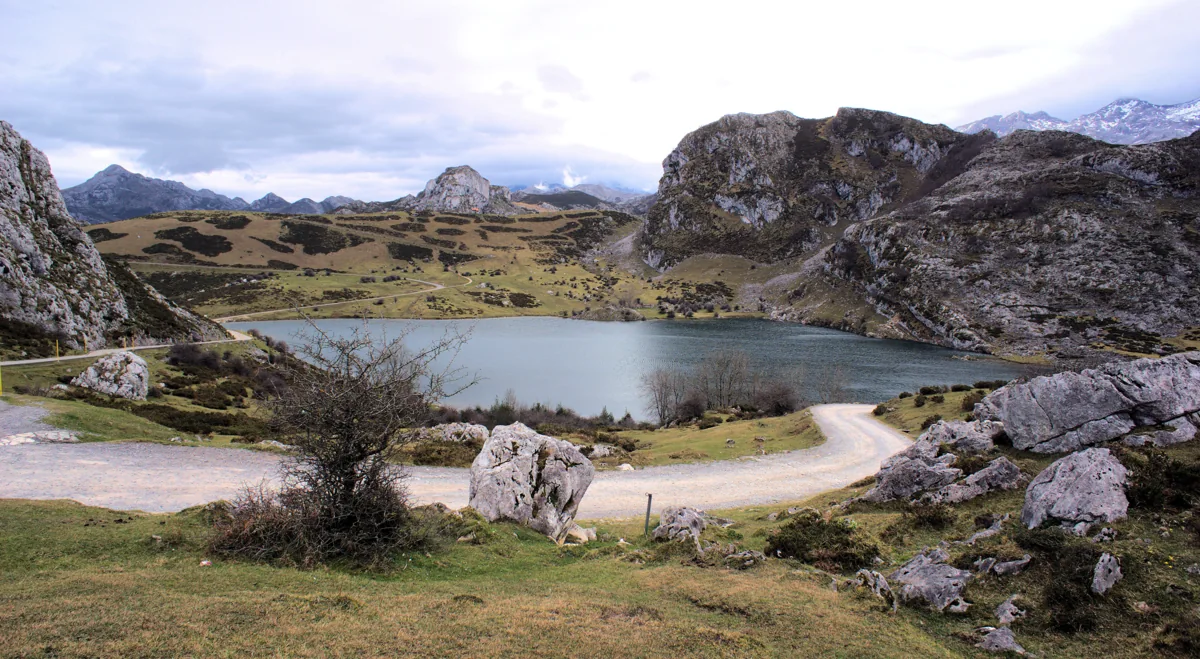
Lake Enol lies among rocky slopes and open grassland, with a winding road in the foreground and snowy peaks in the distance.

Lake Enol in the Lagos de Covadonga sector of Picos de Europa National Park, photographed in February 2024.

Lago de Enol, Covadonga.jpg — Coralma* / Wikimedia Commons / CC0 1.0 · Creative Commons

Walks and routes

Short lake circuit via Entrelagos

MITECO lists this circular option as 3 km and about 1 hour of walking. From Buferrera, the signed visitor route takes in the Pedro Pidal area and Buferrera mines before Ercina; the short return goes over Entrelagos towards Enol and back to Buferrera. Add time for exhibits and stops.

The official leaflet describes stone paving and shows stairs in the visitor-area approach; the Entrelagos section climbs and descends. Ask staff about a shorter suitable option if steps or uneven surfaces are a barrier.


Short lake circuit via Entrelagos

Longer lake circuit through Palomberu

MITECO describes a 5 km, 2½-hour circuit continuing from Ercina behind Mosquital, through the Bricial area and Palomberu beech wood, then across Vega de Enol to Buferrera. Choose it for the woodland-and-pasture contrast, with extra time for the centre and rests.

This is an outdoor mountain walk with uneven ground, rather than an adapted circuit. The published route entry gives a 50 m height difference; it does not describe every step or slope you will encounter.

Longer lake circuit through Palomberu

A relaxed first visit

Arrive with time to get oriented at Buferrera. If Pedro Pidal is open, spend about an hour on the centre and model before following the shorter lake route. Add unhurried pauses for the mining area and views, keeping the final part of your visit close to the return-bus stop. If the centre is closed, use the outdoor interpretation that is open and shorten the day to suit the weather.

Things to try

Try a three-texture challenge

From a safe place on the path, look for three contrasting textures: rippled water, rough limestone and soft-looking grass. Sketch them or take close-up photographs without trampling vegetation. Ask which shapes might have been left by ice and which might be changing with water today.

Look for the human story

Use the Buferrera interpretation to connect the mining remains with the landscape around the lakes. Follow the public visitor route and any barriers; an interpreted mining area is not permission to explore unmarked shafts or cavities.

Spend ten quiet minutes watching

At a safe stopping place, put the camera away for a moment and watch the skyline. Follow one bird’s movement rather than trying to identify every distant shape. A notebook and binoculars make the pause rewarding even when wildlife is far away.

Keep the day flexible

If Pedro Pidal is open and access is safe, spend longer with the exhibitions and leave the lake circuit for clearer weather. If the centre is closed or conditions are poor, stay lower down and change the day’s plan rather than climbing into the mist to use a booking. Rain and fog alone are not grounds for a bus refund under the operator’s published conditions.

Wildlife and habitats

Alpine chough

Watch the birds moving between crags and open feeding ground. If one comes close enough, compare it with the park’s identification material; do not use food to draw birds towards you.

Griffon vulture

Look for large birds gliding above the ridgelines and enjoy the sense of scale they give the mountains. Watch from the path without searching for nesting cliffs.

European beech

On the longer walk, notice how the feel of the route changes in Palomberu’s beech wood. Across the park, beech foliage makes the seasons visible: fresh growth, summer shade and autumn colour.

Black woodpecker

A woodland species to learn about before exploring the wider park. Listen quietly for woodpecker activity, and use a field guide or the visitor centre to help identify what you hear rather than assuming every drumming bird is this species.

Cantabrian chamois

This mountain mammal is part of the park’s wildlife story. Learn its name at the centre and, if you see an animal at a distance, watch quietly rather than following it onto steep ground. Treat an encounter as a bonus to the landscape.

These species are documented in the national park; a short visit to the lakes is not a wildlife checklist. Keep a respectful distance, never feed or follow animals, and enjoy whichever signs of life you happen to notice.

Stories and discoveries

Ice shaped the view; water keeps changing it

The lakes sit in a landscape strongly shaped by glaciers. Limestone also lets water travel through cracks and underground passages, helping explain why this wet mountain range can have surprisingly little surface water higher up. Look for the contrast between lake basins, rock and pasture.

The green spaces are a working landscape

Grazing and mountain communities are part of Picos de Europa’s history and present. Give livestock space, respect private ground and use the signed paths through the landscape.

One park, three mountain massifs

The western, central and eastern massifs have different shapes and approaches. Covadonga offers an introduction to the western massif; it does not stand in for a complete tour of all three.

When to visit

Spring

Snowmelt and unsettled weather can still affect the upper landscape. Choose the lake visit only when the road, paths and forecast suit your group; spring on the calendar is not a promise of summer walking conditions.

Summer

Longer daylight makes an unhurried outing easier, but the visitor area is busy and mist can still settle quickly. Book transport ahead and carry a warm layer even if the valley feels hot.

Autumn

Woodland colour is a good reason to choose the longer circuit on a clear day. Allow for earlier darkness and reduced centre opening; use the date on your transport booking rather than an old timetable.

Winter

Snow, ice and restricted services can make a casual lakes walk unsuitable. If you do not have the skills and equipment for the actual conditions, save the circuit for another day and choose an open indoor visit lower down.

Getting there and practical advice

Pedro Pidal visitor centre

Look for the exhibitions, audiovisual displays and model explaining the park. The published 2026 programme lists 10:00–17:30 on opening days, including the remaining October weekends. Confirm your date and which exhibition areas are available; an earlier works advisory remains on the page. Park contact: +34 985 848 614 or [email protected].

Outdoor interpretation at Buferrera

The centre area includes an arboretum, recreation space and mining interpretation. Use the signs to see which parts are open, and allow for steps between different elements rather than treating the whole area as level.

Toilets, food and drinking water

The official visitor leaflet marks toilets around the Buferrera interpretation area, but check their current availability and accessibility before starting a circuit. Bring drinking water and a picnic or snack; do not make your day depend on an open café or a spring.

Budget for the journey

Checked on 16 October 2026, the official bus pages list an adult return fare of €9 and designated parking at €3 per vehicle per day. Confirm the total for your date and party at booking. Published child-age bands differ between pages, so check the fare for each child directly.

Getting to the lakes

Cangas de Onís is the practical gateway for this outing. On regulated dates, the Covadonga–Lagos road is closed to unauthorised private vehicles for the full day. Choose the official bus service and use the departure stop and line on your booking; allow extra time for parking. The road to Covadonga sanctuary and the road onwards to the lakes have different access arrangements.

Book enough time at the top

Select both journeys before travelling. The operator sets a minimum 2½-hour stay at the lakes, and says the return leg cannot be changed on its own. Choose more time for the longer walk. Confirm date-specific services rather than assuming a timetable shown for summer also applies in autumn or winter.

Special transport arrangements

If you use a wheelchair or other mobility equipment, contact the bus operator and park before booking to confirm the vehicle, boarding point and any authorised access arrangement. If travelling with a pet or assistance dog, ask for the applicable transport conditions as well as the park’s rules.

The lake paths

The short option is stone-paved, but the official leaflet describes steps near the centre and a climb to Entrelagos. Wet stone, snow and ice can make movement harder. Ask staff about the exact section that fits your needs; neither complete lake circuit is presented here as wheelchair-accessible.

Plan the whole approach

Confirm the route from your drop-off point to the centre, current access to displays, toilets and a place to rest. The scheduled works notice does not prove all facilities have returned to their earlier arrangement. A brief centre-and-view visit may suit you better than committing to a full circuit.

Visitor information

Planning checked on 16 October 2026. The park’s new Cares bridge-maintenance notice prevents the complete through-route until works finish; the older rockfall reopening notice does not remove that restriction. For the lakes, check today’s road, weather and path advice, plus Pedro Pidal’s opening date, before travelling.

Sources and useful links

Wildlife you might spot

5

Each card links to a full Explore page with photos, traits, and fun facts.

Snap map for this place

Start with the big picture, then zoom in to explore individual wildlife observations around this place.

Loading map…

Good to know before you go

Check the park’s latest alerts, mountain forecast, road restrictions and your return-bus booking before setting out.

On regulated days, private vehicles without specific authorization cannot use the Covadonga–Lagos road at any hour. An early start is not a way around the restriction.

Wear shoes with grip and carry waterproof and warm layers, sun protection, food and enough drinking water. Do not rely on springs around grazing land.

Keep to signed routes. If visibility deteriorates, avoid committing to the longer circuit or improvising a shortcut.

Give grazing animals plenty of room, keep children close and close livestock gates after passing, unless a sign instructs otherwise.

Keep dogs on a lead and confirm the operator’s pet-transport arrangements before booking a bus journey.

Leave plants, rocks and wildlife undisturbed, take litter home and keep out of the lakes. Do not fly a recreational drone.

Leave a generous return margin. Mobile reception is uneven, so save practical information before travelling; call 112 in an emergency.

Frequently asked questions

No. They are a visitor area in the western massif, in Asturias. The park also extends across Cantabria and León. Treat other valleys and entrances as separate excursions rather than additions to this walk.
Start with the short option if you want more time for the centre and pauses. Choose the longer one only with enough daylight, suitable footwear and good visibility. The route descriptions explain the different published distances.
For a regulated-day visit, book the bus in advance through the official operator and check both departure times. The booking page sets a minimum stay of 2 hours 30 minutes at the lakes. Centre opening and road permission are separate questions.
No. Enjoy Enol and Ercina from the permitted paths and shores; bathing in these lakes is prohibited.
Do not assume the complete circuit will suit it. There are paved sections, but also steps and gradients. Contact the park before travelling to agree an appropriate approach and visit, then confirm transport arrangements separately.
Plan it as a separate mountain outing. On 16 October 2026 the park displayed a new bridge-maintenance closure preventing the complete through-route. An older reopening notice concerns another incident; check the latest specific notice before making plans.
Change the walking plan to suit the conditions. The operator says ordinary rain or fog does not itself entitle you to a refund; safety cancellations follow different arrangements. Read the terms for your booking before paying.

Recent snaps at this place

View all ›

Take the discovery with you

Exploring Picos de Europa National Park?

Identify the wildlife you spot, learn as you go, and keep a collection of the adventure.

  1. 1Spot it
  2. 2Snap it
  3. 3Keep the discovery