





Black-headed Grosbeak
Pheucticus melanocephalus
The Black-headed Grosbeak is a colorful bird with a bright orange body and a black head. They love to sing beautiful songs and can be found in forests and gardens, especially during spring and summer.
Habitat: Forests
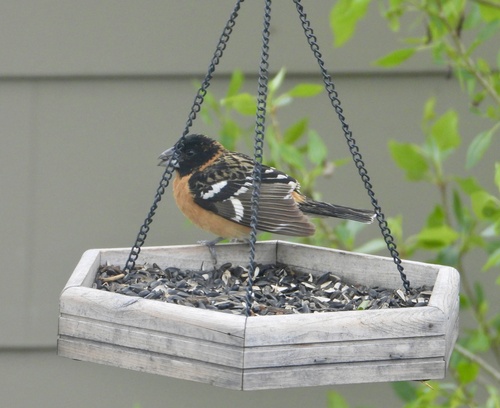
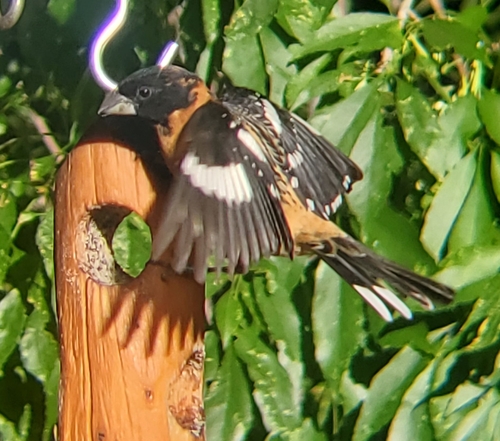
The Black-headed Grosbeak male has a striking black head, rusty-orange breast, and black wings with prominent white patches. Females are streaky brown with yellowish underparts and distinct facial markings, setting them apart from similar songbirds.
Category
BirdsRarity
Common
Danger
1/5 · Very low
Snaps
25
Baby grosbeaks are born blind and featherless, relying entirely on their parents for food!
Males often sing while sitting on the nest, a rare behavior among most bird dads!
Their powerful beaks can even crack open hard snail shells, a unique bird superpower!
These birds enjoy eating sweet fruit and are sometimes seen in backyard orchards!
Black-headed Grosbeak has a massive, conical bill that helps them crush even the toughest seeds with ease.
Black-headed Grosbeak can eat many types of garden insects, because they are opportunistic omnivores.
Black-headed Grosbeak has a rich, flowing, robin-like song that helps them defend territory.
These birds are omnivores, enjoying a mix of insects, seeds, and sweet fruits like berries.
Feathered describes animals, primarily birds, possessing a covering of feathers.
Social animals live in organized groups, cooperating for survival benefits such as foraging, defense, and raising offspring.
This trait identifies organisms whose diet includes both plant and animal matter.
Singing animals produce complex vocalizations, often for purposes of attracting mates, defending territory, or communicating within their species.

Colorful describes organisms or objects displaying a wide range of bright and distinct colors.

Forest habitats are terrestrial environments dominated by dense tree cover, supporting a high diversity of plant and animal life.

Diurnal animals are primarily active during daylight hours, typically resting or sleeping at night.

Migratory animals undertake seasonal movements from one region to another, typically in response to changes in climate or food availability.
No aliases listed yet.
Danger
1/5 · Very low
Enjoy watching birds from a distance and don't disturb their nests.
The easiest way to identify Black-headed Grosbeak is to use the Snappit nature identifier app.
18-20 cm
31-33 cm
0.035-0.049 kg
5-10 years
40 km/h
These birds are omnivores, enjoying a mix of insects, seeds, and sweet fruits like berries.
Forests
Zoom in to split clusters and explore where this object has been snapped.
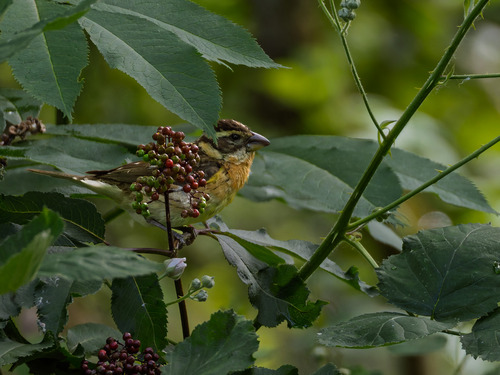
Jun 7, 2026
Photo attribution
no rights reserved
License: CC0 1.0 ↗
Image may be shown cropped inside the card frame.
May 28, 2026
Cushman DamPhoto attribution
no rights reserved
License: CC0 1.0 ↗
Image may be shown cropped inside the card frame.
May 20, 2026
Cheyenne Botanic GardensPhoto attribution
(c) Austin Saunders, some rights reserved (CC BY)
License: CC BY 4.0 ↗
Image may be shown cropped inside the card frame.
May 10, 2026
Madera CanyonPhoto attribution
no rights reserved
License: CC0 1.0 ↗
Image may be shown cropped inside the card frame.

New Mexico, US
You might spot Tree Cholla, Colorado Pinyon, and House Finch.
View guide →

Washington, US
You might spot Pacific Banana Slug and Oregon Forestsnail.
View guide →

California, US
You might spot Western Fence Lizard and Pacific Poison Oak.
View guide →

Montana, US
You might spot Western Ponderosa Pine and Great Horned Owl.
View guide →

Washington, US
You might spot Barrow's Goldeneye and Pacific Banana Slug.
View guide →

Wyoming, US
You might spot Moose, Uinta Ground Squirrel, and American Bison.
View guide →
Take the discovery with you
Snap it with Snappit to identify it, learn what makes it special, and add the discovery to your collection.




.jpg&width=800)
.jpg&width=800)






