





Common Gallinule
Gallinula galeata
The Common Gallinule is a fun bird that loves to swim and walk around wetlands. It has a colorful body and a funny, loud call that sounds like a squeaky toy!
Habitat: Wetlands
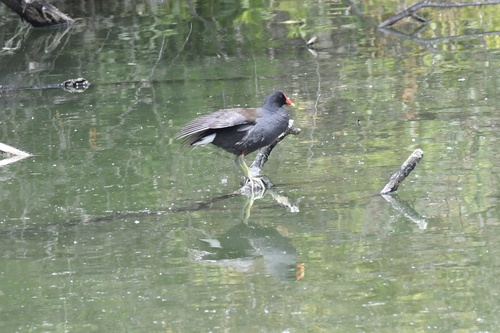
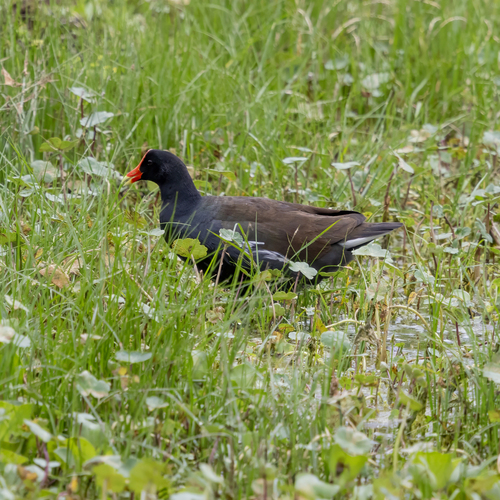
The Common Gallinule is a medium-sized water bird with a slate-gray body, a striking bright red frontal shield extending onto its yellow-tipped bill, and a distinct white stripe along its flanks. Its long, greenish-yellow legs lack webbing, setting it apart from true coots.
Category
BirdsRarity
Common
Danger
1/5 · Very low
Snaps
27
Despite their long toes, they are excellent swimmers, paddling their unwebbed feet rapidly.
Gallinules make a loud "krrruck" call, sounding like a chicken clucking near the water.
Its babies have a tiny claw on their wing, like a dinosaur, to help them climb!
They build floating nests anchored to plants, rising and falling with water levels.
Common Gallinule has super long toes and unwebbed feet that help them walk right on top of floating lily pads and plants.
Common Gallinule can dive underwater for up to 30 seconds because of its strong leg muscles, helping them hide from predators.
Common Gallinule uses a unique head-bobbing motion that helps them signal intentions to other gallinules, especially during courtship.
These omnivores eat a mix of plants, insects, and small aquatic creatures!
Age differences: Young gallinules eat more insects for protein to help them grow quickly.
Characterized by having toes connected by a membrane, typically aiding in swimming.
Social animals live in organized groups, cooperating for survival benefits such as foraging, defense, and raising offspring.
This trait identifies organisms whose diet includes both plant and animal matter.
Colorful describes organisms or objects displaying a wide range of bright and distinct colors.

This habitat trait identifies species found in wetlands, which are areas of land saturated with water, either permanently or seasonally, including marshes, swamps, and bogs.

Diurnal animals are primarily active during daylight hours, typically resting or sleeping at night.

Freshwater habitats include non-saline aquatic environments such as rivers, lakes, ponds, and wetlands, vital for numerous species.
Danger
1/5 · Very low
Always watch birds from a distance and don't try to touch or chase them.
The easiest way to identify Common Gallinule is to use the Snappit nature identifier app.
30-38 cm
50-60 cm
0.2-0.5 kg
2-9 years
50 km/h
These omnivores eat a mix of plants, insects, and small aquatic creatures!
Wetlands
Zoom in to split clusters and explore where this object has been snapped.
Jun 6, 2026
Mount EcclesiaPhoto attribution
(c) zr217, some rights reserved (CC BY)
License: CC BY 4.0 ↗
Image may be shown cropped inside the card frame.
Apr 26, 2026
AfricatownPhoto attribution
(c) Dan Vickers, some rights reserved (CC BY)
License: CC BY 4.0 ↗
Image may be shown cropped inside the card frame.

Hawaii, US
You might spot Brown Anole, Gold Dust Day Gecko, and Red-Crested Cardinal.
View guide →

Florida, US
You might spot Crested Anole, Brown Anole, and Peters's Rock Agama.
View guide →

Florida, US
You might spot Brown Anole, White Ibis, and Anhinga.
View guide →

South Carolina, US
You might spot American Alligator, Great Blue Heron, and Anhinga.
View guide →
Hawaii, US
You might spot Gold Dust Day Gecko, Sea Turtle, and Brown Anole.
View guide →

California, US
You might spot Mule Deer, Turkey, and Duck.
View guide →
Take the discovery with you
Snap it with Snappit to identify it, learn what makes it special, and add the discovery to your collection.





.jpg&width=800)









